How to find and compare business energy quotes (and pick the right one)

Let's demystify quotes. No, not the ones on signs in your kitchen (no disrespect to 'Live, Laugh, Love'). We mean business energy quotes: the ones suppliers give you to say how much their electricity and gas will cost.
Today, we'll look at how to find them, compare them and choose the best one for your business. Taking a few minutes to compare now can save you overpaying for months.
The short answer
To compare business energy quotes, get a few from different suppliers using the same details: your address, annual usage and contract end date. Then compare the total annual cost, contract features and supplier features. Finally, choose the quote that matches what matters most to you.


When should I get a business energy quote?
You can look around at any time. If you’re in the middle of a contract, you might not be able to switch just yet. But it doesn’t hurt to look. Some suppliers, like Octopus, give you an instant quote online with no obligation.
It’s particularly timely to look for quotes if:
you’re in the last few months of an energy contract
your energy contract has ended
you’ve moved into a new place
your energy contract is variable and doesn’t have a fixed term
How to find and compare business energy quotes in 5 quick steps:
Gather your address, annual usage and contract end date
Use these details to collect quotes from a few different suppliers
Compare the total annual costs, features, reputation and perks (you can use our free scorecard tool)
Look out for hidden broker fees and mid-contract price rises
Choose the quote that best fits with your priorities
How do I start finding business energy quotes?
Right. It’s detective time. And you’re Sherlock Holmes (or should that be Sherlock Businesses?). The mystery of the best business quote is afoot. Let’s crack it.
Here’s what you’ll need to do, step by step:
Step 1: Grab your quote comparison scorecard
We’ve put this together to make it easier to compare your quotes. You can either print it or copy it into a spreadsheet.
For each quote, fill in a column on the scorecard. Consider this the notebook where you collect your clues. You’ll use this later when it’s mystery-solving time.
It's split into three areas:
Pricing: all the things that'll make up your energy costs
Contract features: the nature of the contract that's on offer
Supplier features: A broader look at the company that's giving you the quote, including other customers' reviews
Step 2: Find your first business energy quote
A quick online search will reveal heaps of suppliers all quaking to give you a quote. So choosing a starting point might feel overwhelming.
Why not start with Octopus? Our quotes are simple, clear and extremely speedy - so it’s a good place to begin.
Get your first quote:
To get accurate quotes from suppliers, have this info to hand:
Your address
Nice and simple - you’ll need to let them know where you want the energy to go.
Your annual energy usage
You can find this on bills from your current supplier. Companies use this to work out how much you’ll need to pay them. It’s measured in kilowatt-hours (kWh).
If you’d like a quote for both electricity and gas, you’ll need the figure for each.
The date you'd like your new tariff to start
If you’re in a contract already, the answer is the day after your current contract ends.
If you’re not in a contract, you don’t have an end date. So you can switch at any time.
Your supply numbers
You’ll find these on your bills too.
Each of your meter points has a unique number attached to it. For electricity, it’s called your Meter Point Administration Number (MPAN). For gas, it’s your Meter Point Reference Number (MPRN).
Not all suppliers will ask for this. But it’s handy to have.
Step 3: Get quotes from a few more suppliers
Do the same again, using info from some different sources. Pop them in your scorecard.
Not all suppliers will tell you the information upfront. They might ask you to call them or fill in a form before they give it to you. If this is the case, note it on the scorecard. It can be a sign that they’re not particularly transparent.
What's the difference between suppliers, brokers and price comparison sites?
A supplier sells you energy directly. A price comparison site shows quotes from several suppliers in one place. A broker seeks out quotes for you.
Suppliers pay brokers and comparison sites to find customers for them. They often roll this extra commission into the customer's final unit rate. So, the customer ends up paying more without realising.
According to our recent survey, 25% of small business decision-makers don't know that brokers may receive commission (YouGov, April 2026).
You won't find Octopus on price comparison sites or through brokers. We only sell directly. In fact, we've been campaigning to make the system better for businesses.
How do I compare business energy quotes?
By now, you have your quotes. You have your scorecard. You have all the facts you need to crack the case.
But there’s one important question to consider first:
What does ‘best’ mean when choosing my business energy supplier?
It depends on what matters most to you. Choosing the best quote means deciding which best matches your priorities.
We asked over 1000 small businesses what they care about most when choosing a supplier. Here’s what they said:
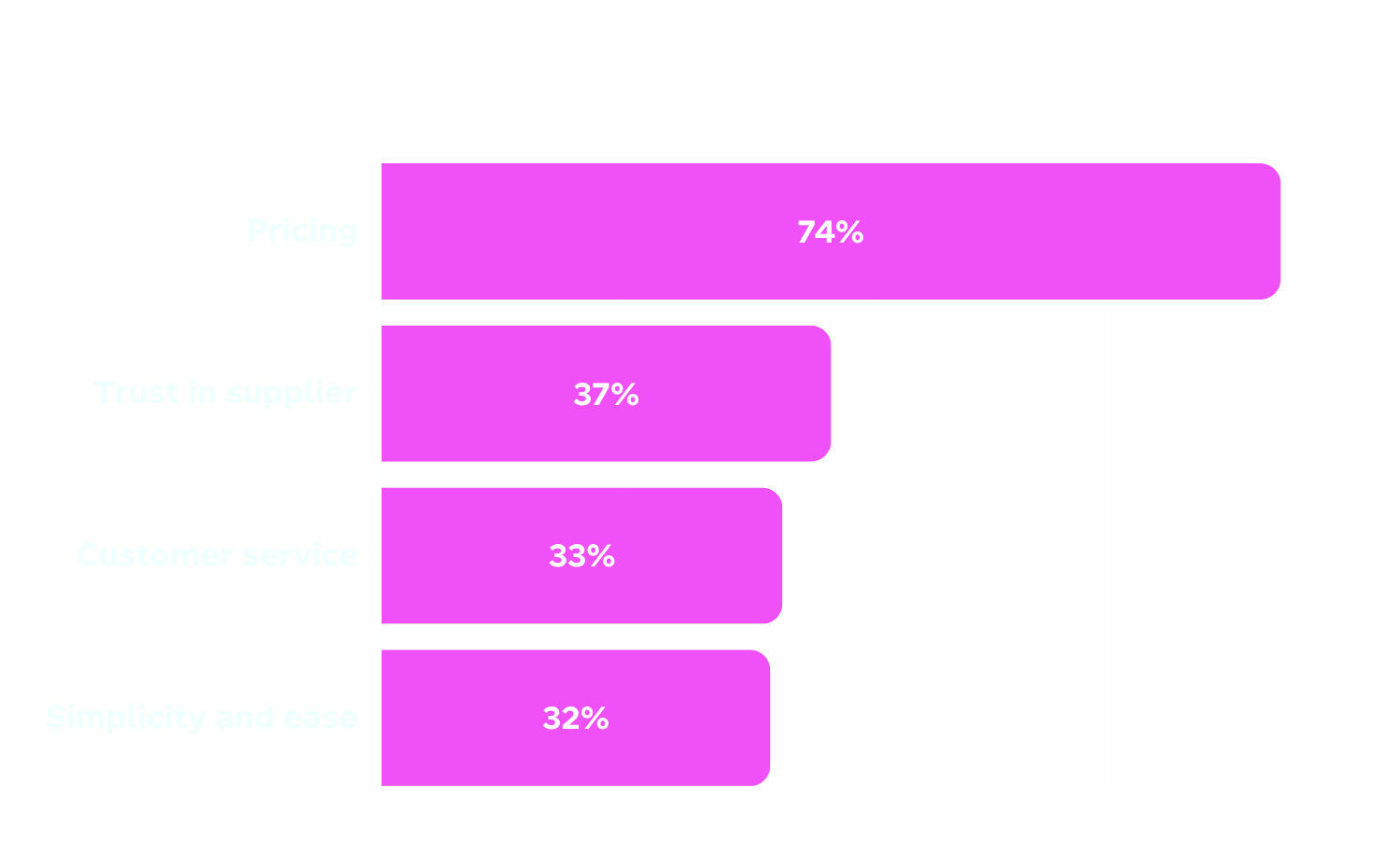
From an Octopus Energy for Business and YouGov survey of 1034 UK SME decision-makers (April 2026).
It’s not surprising to see Price at the top of this list. It’ll always be a deciding factor. But remember, it’s not just about finding the lowest price. It’s about getting good value: paying the right amount for the quality you’re getting.
Trust in supplier is key as well. You need to know the supplier won’t up their rates, treat you badly or disappear.
Octopus Energy for Business is Britain's most trusted energy supplier.
Similarly, Customer service is a big consideration. When you need help, your supplier should be there for you. They should be quick, sympathetic and stop at nothing to fix your problems.
Octopus is the only energy supplier to win 9 consecutive Which? awards.
And then there’s Simplicity. Some companies make business energy feel complicated. As a result, customers feel like they need more help.
But it doesn’t have to be like that. You can find a supplier that makes business energy easier, not harder. Easier to switch, easier to manage, easier to trust.
Let's compare your business energy quotes
Ok, back to your scorecard. Let’s review area by area:
Pricing
For each quote, you should have a unit rate, standing charge and annual cost. They fit together like this:
(Unit rate x
annual kWh usage)
+
(Standing charge x
365)
=
Annual energy cost in pence

If there's anything in the 'Additional costs' row for the quote, add that on top. (Not sure whether your quote's hiding any extra levies or fees? Send it over to us - we'll check for you.)
The annual cost figure is the best one to compare between quotes. But take note of the unit rate and standing charge too. They can vary a lot.
If the unit rate’s high and the standing charge is low, you have more control over your bills. Your usage is forming a larger chunk of your costs, so bringing it down will lower your bill overall. If your standing charge is relatively high, though, changes in usage affect overall cost a bit less.
Quick note: you may also pay VAT and Climate Change Levy on your energy usage. Check whether each supplier includes this in the price they give you.
Contract features
These extra clues help you to spot your ideal supplier. Personal preferences are important here:
Contract length: Shorter options mean you’re locked in for less time. In as little as a year, you’ll be able to shop around again. Longer options guarantee your rates for multiple years, so you won’t have to renew again for a while.
Fixed vs Variable: Fixed prices should stay the same for the whole contract. Variable prices can change at any time.
Can prices change?: Some suppliers change your rates mid-contract or add on extra fees. This makes them look cheaper initially, becoming pricier throughout your contract. When getting a quote, check with the supplier whether they ever do this.
Supplier features
When comparing quotes, don’t just think about the contents of the quote itself. Take a look at the supplier providing it:
Trustpilot rating: Each supplier’s Trustpilot score comes from real customers’ reviews. So, it’s a pretty good indication of how good the service is and how much customers trust them. Here’s ours, for example. The closer to five stars, the better.
Contact options: Sometimes, you just want to speak to a human. But some suppliers are harder to reach than others. If they're reachable by email and phone directly, it’s easier to get help.
Perks: The extra bonuses they can bring to your business. Do they have a rewards programme, like Octoplus? Easy ways to lower your bills, like Electric Match Club? Smart tariffs to boost your savings, like Shape Shifters? These can make a big difference to your experience with a supplier.
Kimbolton Vets are cutting costs with Shape Shifters
By making a few small changes, Becky and her colleagues are unlocking big savings.
That means more money to reinvest in her practice - and in her patients of course (did someone say treats?).
How do I decide which is the best business energy quote?
Here we are - decision time! This bit is all about assessing which quote best matches your priorities. Here's a quick guide, using the facts you gathered on your scorecard:
| If your priority is ... | Look at ... |
|---|---|
| Great value | Pricing, extra costs, Trustpilot rating, perks |
| Trust | Extra costs, mid-contract price changes, Trustpilot rating |
| Customer service | Trustpilot rating, contactability |
| Simplicity | Contract features, Trustpilot rating |
So, there you have it. A comprehensive way to consider and compare your quotes. Case closed 
Why do businesses love Octopus?
While we’ve got you, here’s a bit more information about one of the suppliers on your list.
You get award-winning service
We're the only energy supplier to be Which? recommended 9 years in a row.
We're not on price comparison sites
We only sell directly. That way, we guarantee that all customers get our best deals.
You can earn goodies with Octoplus
Our rewards programme unlocks freebies and offers, from coffees to cinema tickets.
We power over 100,000 businesses.
Our business customer base reached 100,000 in early 2026 - and we've continued growing since.
We're rated 4.9 out of 5 (Excellent) on Trustpilot.
Head to our Trustpilot for up-to-date ratings and reviews.
No brokers, no hidden fees.
We don't work with energy brokers. You won't find us on price comparison websites. That means there's no commission or third party charges hidden in your rates. It's one of our pricing principles that keep your rates fair.
Our pricing is transparent.
When you sign up, we show you exactly what you'll be paying for. Our bills do this too.
We also have guides to help you understand your energy prices better, like this one.
With us, your fixed price is just that: fixed.
We don’t change it during your contract term. We don’t sneak on extra fees. It's one of our pricing principles that keep your rates fair.
You can get a quote in under a minute.
Our data shows that business customers get an online quote in 44.1 seconds, on average.
Here's how we worked it out:
We measured the duration of a big sample of online user journeys from 1/6/26 to 16/7/26
We excluded business portfolios that are complex, multi-site or extremely high-consuming
The timer started when a user reached the Quote page, before putting in any details
The timer stopped when they saw the first set of tariff quotes
We calculated the average time from start to stop as 44.1 seconds
You can sign up in under 10 minutes.
Our data shows that, for 20% of SMEs, signing up online takes less than 10 minutes.
Here's how we worked it out:
We measured the duration of a big sample of online user journeys from 1/6/26 to 16/7/26
The timer started when a user reached the quote page, before putting in any details
The timer stopped when they reached the success page, meaning the sign-up was complete
We calculated that 20% of SMEs did the whole process within 10 minutes
We give customers award-winning service.
Octopus Energy has won loads of awards for customer service. In fact, we're the UK's most awarded energy supplier.
Octopus Energy is Britain's biggest supplier, trusted by over 8 million homes.
You can find all the data here.
We show you exactly what goes into your bill
Our bills are itemised, so you can see how much of the cost comes from usage and other charges.
They also direct our customers to these even more detailed explanations, if they're interested.
1 in 3 small businesses don't realise that energy brokers get paid commission.
This is based on a May 2026 YouGov survey with 1034 UK SMEs.
'Small businesses' refers to the micro-business segment, which represents c.95% of total UK SME businesses (source: UK Parliament).
We lobbied the government to regulate brokers and now they're doing it.
Check out our campaigns for a better broker system, including the success we've had so far.
Updated on

Pete McNally
Content Manager at Octopus Energy For Business
Published on 13th October 2026