The “Complexity Tax” quietly holding UK SMEs back

We asked more than 1,000 UK SMEs how they really feel about business energy. Their responses suggest the challenge isn’t just the cost of energy, it’s the complexity of actually navigating it.
Running a business has never been easy. Every day brings decisions about customers, cash flow, staffing and growth. Energy should be one of the simpler things to navigate. So we wanted to know what businesses think the industry could do better.
The answers paint a picture of a market where the challenge isn’t simply rising prices. It’s the growing burden of understanding, comparing and navigating business energy itself, creating a hidden cost measured in time, uncertainty and missed opportunities. It’s a cost we think deserves a name: The Complexity Tax
The headline insights...
Energy is affecting growth: around 6 in 10 say energy costs have negatively affected their business, while just over half say they’re limiting growth or investment.
Energy is harder to understand than it should be: 47% believe they could save money if pricing and contracts were easier to understand, while only 27% were confident that they understood how their bill is calculated.
Trust is low: just 18% trust suppliers to offer fair pricing, and 46% describe the market as confusing or unfair.
Businesses want more transparency: around a third use brokers or comparison sites, yet 1 in 4 didn’t know brokers may receive commission.
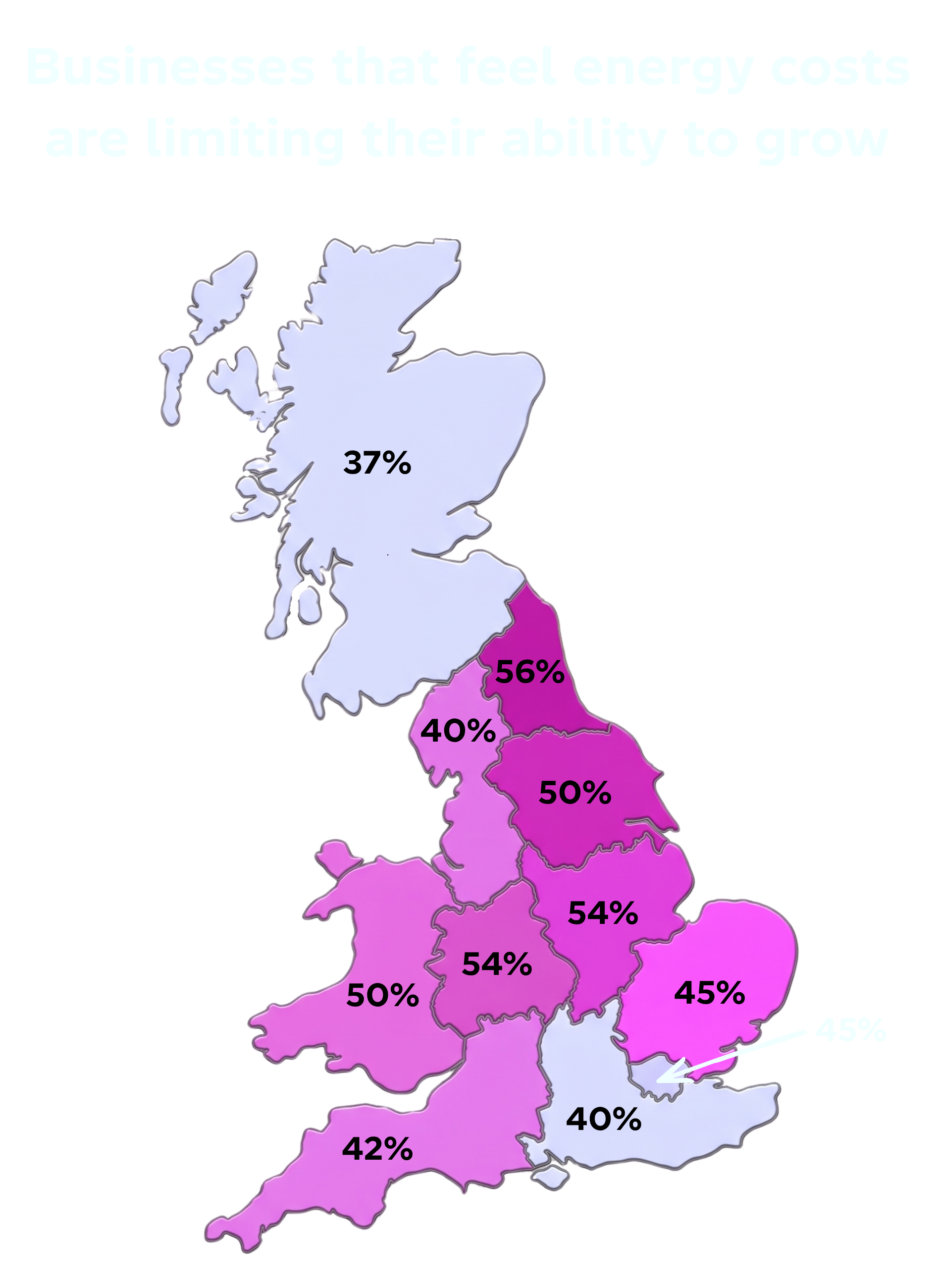
Energy challenges vary across the UK: 56% of SMEs in the North East say energy costs are limiting growth or investment vs 41% in the South.
62% of SMEs know solar can cut energy costs, but upfront costs, uncertain returns and complexity are holding adoption back.
52% know about smart or flexible tariffs, yet many aren't taking them up, suggesting the opportunity is there, but uncertainty still remains.
Energy costs are affecting business growth
When we asked SMEs about the impact costs are having on their businesses, the answer was clear.
Around 6 in 10 told us energy costs had negatively affected their business over the past year. Around half said those costs were limiting their ability to grow and their decisions around what to invest in.
52%
say energy costs are limiting growth or investment.
47%
believe they could save money if pricing and contracts were easier to understand.
18%
of SMEs trust energy suppliers to offer fair pricing.
When things aren’t clear, it’s hard to know who to trust
One of the strongest messages we heard was about trust. Only 18% of SMEs trust their energy suppliers to offer fair pricing.
Half are skeptical about supplier pricing, while 38% don’t believe they’re paying a fair price for energy.
It’s difficult to build trust when customers aren’t sure how prices are set, what’s included in what they’re paying for or whether they’re getting a fair deal.
Business energy is harder to understand than it should be
Businesses shouldn’t need to become energy experts just to buy their energy with confidence, or pay commissions to third parties that could stand to benefit from this confusion.
Price is clearly important. But when we asked businesses about navigating the energy market, we heard something else too. It’s difficult to actually know whether they’re making the right decision.
Almost half of SMEs believe they could save money if energy pricing and contracts were easier to understand.
Only 27% strongly understand how their energy bill is calculated, and 46% describe the market as confusing and unfair.
When energy is complicated, businesses are forced to find “help”
With the market this confusing, it’s only natural that businesses look for someone who can help.
Around a third of SMEs told us they use brokers or comparison websites. But our research also highlighted a worrying knowledge gap.
25% of SME decision-makers don’t know that brokers may receive commission, and among micro-businesses that rises to 1 in 3.
For years, we’ve worked to make brokers and comparison sites work better for businesses. We’re glad about the latest Ofgem announcement to regulate, but regulation alone won’t remove this Complexity Tax.
77%
believe broker commission should be clearly disclosed
78%
want unsolicited contact from brokers to stop
The regional picture is much more nuanced
The impact of energy isn’t felt evenly across the UK.
In the North, 46% of SMEs say energy costs are limiting growth or investment, compared with 41% in the South. In the North East, that rises to 56%.
In London, 60% believe they could save money if energy pricing and contracts were easier to understand, compared with 47% nationally.
And in Scotland, 63% are sceptical about supplier pricing, compared with 50% across the UK.
The numbers vary by region, but the underlying challenge is the same. Energy can create costs beyond the bill itself.
So what does this all mean?
Taken individually, these findings are about pricing, trust, brokers, contracts and technology.
Taken together, they paint a bigger picture. The Complexity Tax isn’t just about making energy feel complicated. It’s about what that complexity costs UK SMEs.
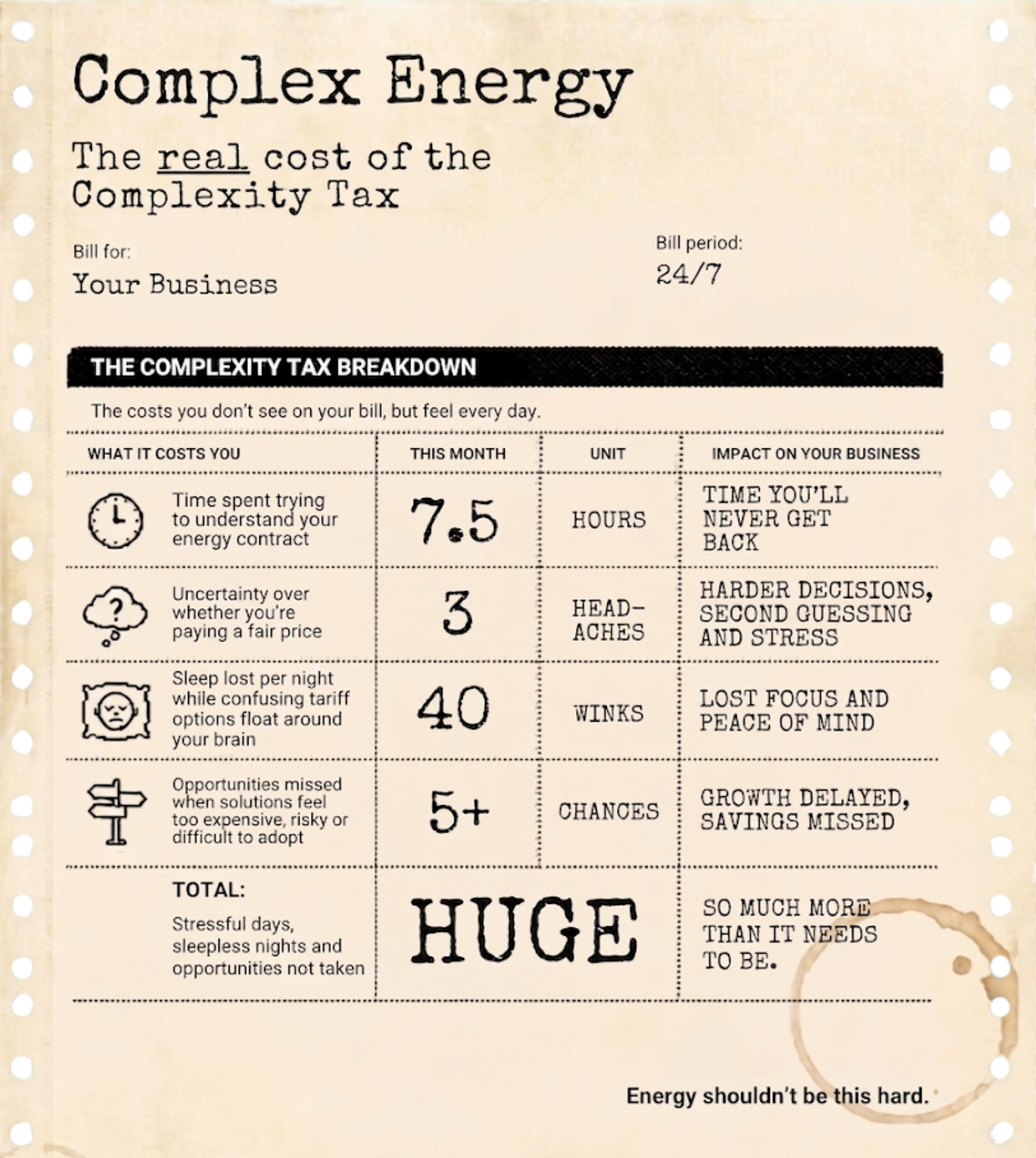
The time spent trying to understand a contract.
The uncertainty over whether you’re paying a fair price
The confidence lost when you don’t understand your bill
The opportunities missed when energy and cost saving technology feels too expensive, risky or difficult to adopt.
None of these costs appear on an energy bill, but they are real costs for businesses already trying to manage enough.
What we’re doing about it at Octopus
Listening is only valuable if it leads to action. Everything we do at Octopus Energy for Business starts with a simple question: will it make things better for our customers?
That’s a big part of why we don’t work with energy brokers and comparison sites. We don’t believe small businesses should have to pay extra fees and charges to get a good energy deal. Instead, we focus on making it easier to buy energy directly, with transparent pricing and straightforward contracts, without hidden fees or mid-contract price rises.
And we’ll keep listening, and continue to use what we learn to make things better for UK SMEs.
About the research
This article and its findings are based on an independent YouGov survey commissioned by Octopus Energy for Business, conducted among 1,034 UK SME decision-makers. The research explored attitudes towards business energy, pricing, suppliers, brokers, smart energy technologies and the wider energy market
Updated on

Jamie Swann
Head of Growth & Marketing
Published on 3rd September 2026