Mind the spark gap: the number that could shape your future energy bills

The "spark gap" is the price difference between electricity and gas. The smaller the gap, the more people decide to upgrade to electric tech (like EVs and heat pumps)
It's narrowing: Gas prices have spiked, making electricity unusually cheap in comparison right now.
Big savings: Heat pumps and EVs on our specialised tariffs now cost less to run than fossil fuel alternatives
Let’s talk about the “spark gap” and why it’s so important. The spark gap is simply the price difference between using electricity and using gas. And, basically, it helps dictate the future of the transition to a sustainable, electric energy system — and what your energy bills will look like in the future.
Every time someone decides whether to replace a gas boiler with an electric heat pump, or whether to stick with a petrol car instead of an EV, they’re looking at running costs: especially because the cost of living crisis is making everyone feel stretched. If electricity is too expensive compared to gas, it might not seem worth making the switch.

Going down . . .
Right now, we are in an unusual situation. In the latest price cap announcement, we learnt that in October, bills are to rise about 4% to a three-year high (even with a 5% VAT haircut on electricity). But the spark gap has fallen 7%, to its lowest level since the price cap began in 2019.
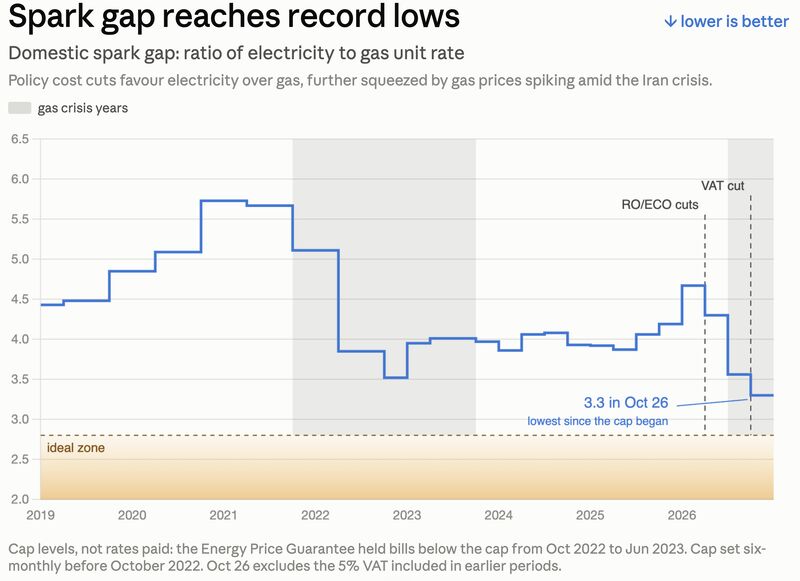
Why is the price gap shrinking?
International gas prices have soared, and those volatile markets hit gas bills much harder and faster than electricity bills.
This is partly because of renewables filling some of the electricity demand. But also wholesale prices make up a much bigger share of the gas bill than the electricity bill, which factors in more fixed costs, such as government subsidies. So even if wholesale prices of electricity and gas both doubled, the gas unit rate might jump by 70%, while the electricity unit rate might only jump 50%. As a result, the spark gap narrows.

What that means for you
All this means that, relative to gas, electricity is currently unusually cheap. If you’ve already electrified your home, this is great news. But if you’re one of the vast majority of households still stuck on gas boilers, you’re much more exposed to punishing international price spikes.
Our recent data shows how much money electrification can save. Live data from thousands of our Cosy heat pumps, which you can check out on the Octopus performance fleet dashboard, shows that 99.6% of customers pay less to heat their homes than they would with a gas boiler.
And the average driver on Intelligent Octopus Go, our EV tariff, saves more than £850 a year compared with running a similar petrol car. With about half a million people using Intelligent Go, this also makes a pretty big dent in the country’s petrol use.
Why electrification matters
Electrification is incredibly important to help make the most of all the clean power we’re building. Ending our dependence on costly, imported fossil fuels doesn’t stop at building wind and solar farms, it also means phasing out petrol cars and gas boilers - reducing household bills and slashing our largest remaining sources of emissions at the same time.
And as electrification grows, so too does demand, and if it’s managed using things like smart meters, batteries, and smart tariffs, it can flex up and down to help out the grid and further reduce your energy bills. But we need electricity to be reliably cheap first to convince people to make the leap and stimulate that demand.
We need change now
Without real change, this temporarily low spark gap will just climb again. The government’s plan to spend £100bn upgrading the grid will eventually push electricity prices up, while wholesale gas prices will likely normalise and fall. If that happens, electrification will hit a brick wall.
We’ve told the government we don’t think it’s necessary to spend anywhere near that much on grid upgrades — the plan is based on a flawed idea of how much power will be needed at “peak” times in the future. Our customers have already shown that they are willing to embrace flexibility, which helps to flatten those peaks, and the rise of home batteries will only help with this.

The real fix isn't just moving money around
We can debate whether certain levies should be funded through bills or general taxation (spoiler: we think more should be funded through tax), and targeted subsidies help those most in need, but this is largely an exercise in robbing Peter to pay Paul. Moving costs around changes who pays, but it doesn't make the underlying electricity any cheaper to produce.
The real answer is structural. We have to make power genuinely cheaper at the source.
What would help
Reforming the market: stopping the waste of wind power, decisively cutting gas out of the mix, and making smarter use of our existing grid so we don't have to wait for slow, mega-expensive new infrastructure.
Thinking flexibly Being smart about when we use energy is a vital piece of the puzzle: getting rewarded in Saving Sessions, switching to a smart, time-of-use tariff and avoiding using power at congested times is one of the most impactful things you can do as an energy customer.
Investing in tech Home batteries help enormously with flexibility and are becoming ever-more popular.
Cheaper, greener power is entirely possible: we just have to build the system to deliver it.
Additional reporting by Nicki Slater-Arnold
Is your home heat pump ready?
Tempted by Intelligent Octopus Go?
Did you know we do EVs too?
Published on

Sam Whitworth
Energy Market Regulation Advisor