Fuelling the future: gas, meters, and the net zero mission

You can’t see it, smell it or touch it, but natural gas powers our lives. Love it or hate it, it fuels millions of homes, cooks our meals, and keeps the lights on.
The UK’s gas story began in the 19th century using coal and oil, but the modern gas revolution truly kicked off in 1959 when we imported our first Liquid Natural Gas. Fast forward to 1965, and the discovery of massive gas reserves in the North Sea changed how the UK uses energy forever.
Understanding gas and its impact
Most gas comes from fossil fuels, but we’re changing the recipe to reach Net Zero. We're exploring cleaner, greener alternatives to power our homes without warming the planet.
| Where does our gas in the UK come from? | |
|---|---|
| International Pipelines | Norway is the UK’s largest supplier, supplying 35 to 45 per cent of the gas we use here. |
| UK Production | The UK still extracts 30 to 35 per cent of its own gas from the UK Continental Shelf (UKCS which includes the North and East Irish Seas. However, extraction has declined since the early 2000s. |
| Liquefied Natural Gas (LNG) | When supplies are short, 15 to 20 per cent of our gas is supercooled to a liquid form and shipped to us from overseas. Our main providers are the US and Qatar. |
So, what else is gas used for?
Domestically, we rely on natural gas mostly for heating and cooking. However, natural gas wears many hats, quietly powering essential parts of our daily lives.
Key uses include fuelling gas-fired power stations - such as Pembroke Power Station - and supporting large-scale food manufacturing, used as a raw material in both the fabric and chemical industries and as a source of transport fuel for the cruise ship industry.
Overall, gas usage in the UK has fallen by about 40% since the early 90s. Gas price volatility and the decline of domestic gas supplies have pushed the UK toward electrifying homes and daily life. However, further work is needed beyond domestic customers to stop using gas completely.
Gas meters - What are they?
Gas meters are tools we use to measure your usage. They're much more than that, though.
Think of your gas meter as if it were 'breathing'. It has an inlet chamber and an outlet chamber (similar to your lungs!).
When you switch on your gas oven or boiler, it 'inhales' the gas to the inlet chamber and then moves it to the outlet chamber to be 'exhaled' for you to use.
It has a diaphragm (again, the same as the one we all have in our bodies!) that moves back and forth to help this exchange. This in-and-out motion turns the dials on your meter to record your usage.
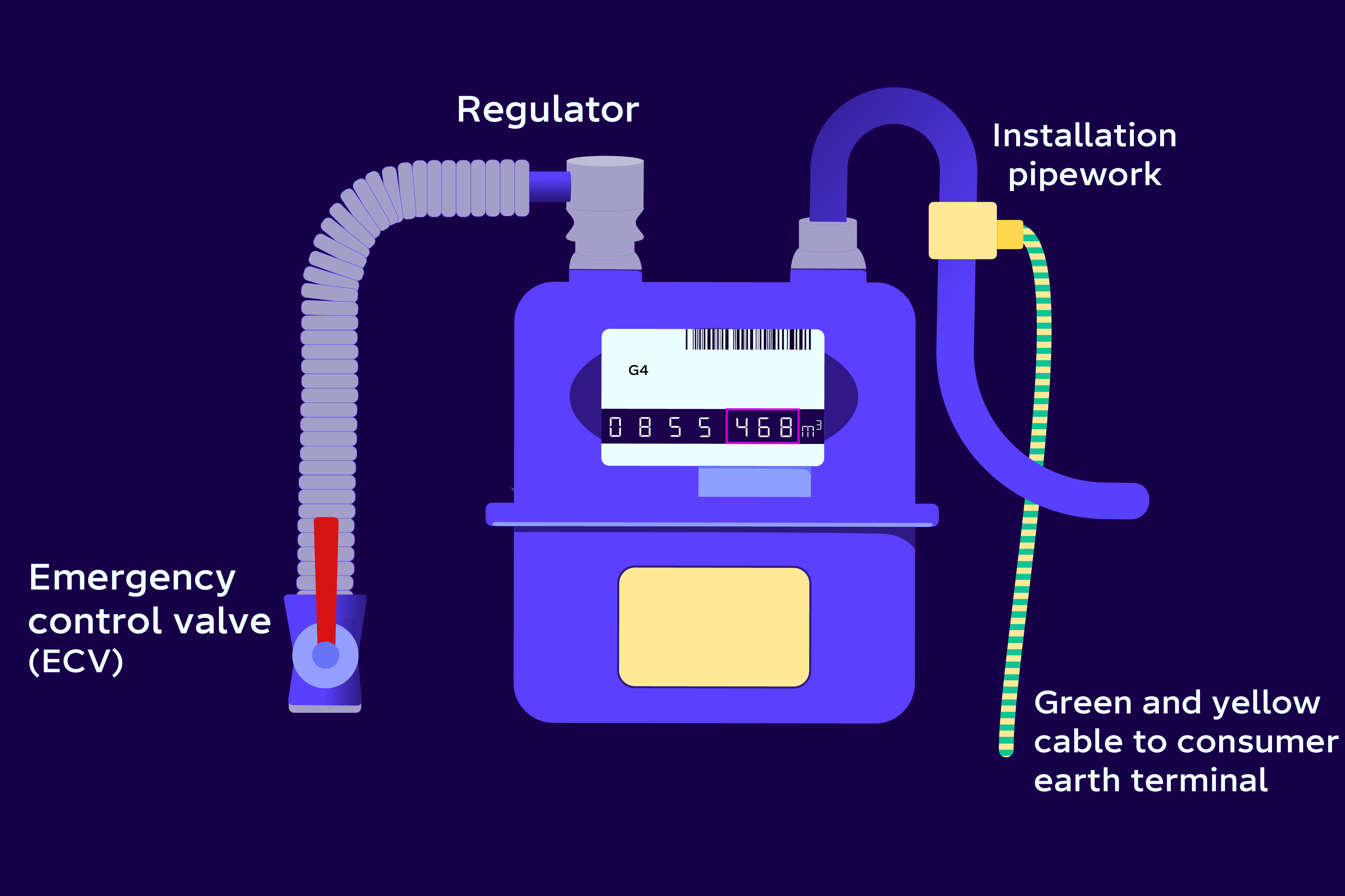
Traditional vs Smart - What's the difference?
Traditional gas meters use mechanical dials to track your gas, while smart meters use electronic sensors. Smart meters automatically send these readings over a secure wireless network directly to us and to your In-Home Display - no manual checks needed!
How does gas billing work?
Your gas meter measures the physical volume of gas you use in cubic meters (m³), but we bill you in kilowatt-hours (kWh).
We convert m³ to kWh and add that to your bill.
We do this so we can charge you for the actual gas you've used, rather than just the space it takes up. The conversion calculation is here.
Gas meter 'tolerance' tests
What does ‘tolerance’ mean?
When a Gas Safe engineer visits your home to inspect or install a gas appliance (such as a smart meter or boiler), they will test the tolerance of the appliance and pipework. They do this to check for leaks and ensure the gas setup at your home is safe.
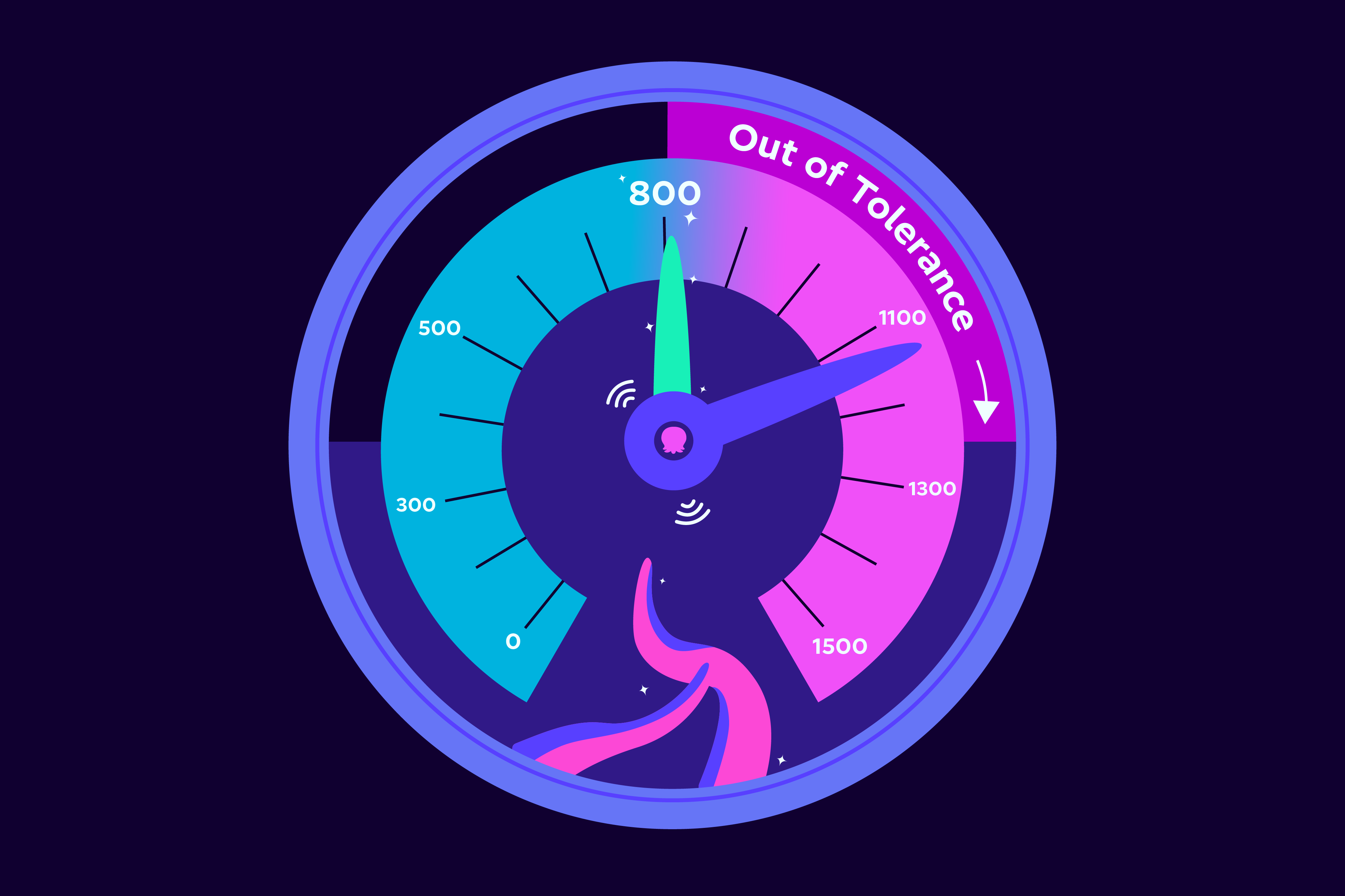
When they measure the ‘tolerance’ on your meter, it means they perform something called a 'tightness test'. The test measures pressure drop levels on the appliance and pipework. This checks that there are no dangerous leaks on the appliance or in the pipework connected to it.
The tolerance is measured in 'millibars'. The test gives your Gas Safety engineer a millibar pressure-drop figure after they’ve done the test, and that number is checked to see whether it falls within the permitted ‘tolerance’ figure set by the government.
So... what is the tolerance on my gas meter?
The tolerance levels for gas installations used to be between 4 and 8 millibars (mb). This was based purely on the size of the meter installed at the property.
However, from the 1st of October 2026, this tolerance has changed. The permissible pressure drop tolerance is now based on the volume of the gas installation and can be as low as 1 mb.
Because each home has a different gas installation, each tolerance will be unique to your home.
This change reflects the gas industry best practices, safety data, and a shift toward precision. Safety has always been at the forefront of our field activities, and this new standard adds an extra safety mechanism for all our customers at Octopus Energy.
What does this mean to me?
From the 1st October 2026, there are significant changes to gas tightness testing, which will be enforced by “Gas Safe”, through The Institution of Gas Engineers and Managers (IGEM).
| What this means in practice: |
|---|
| - Before installing your meter, the engineer will take a little extra time to calculate your system's safe pressure limit. |
| - If the pressure drop is too high, the engineer must find and isolate the leak. |
| - To trace the leak, the engineer will turn off each gas appliance - like the boiler, hob, or gas fire one by one until the pressure drop returns to a safe level. |
| - Once our engineer finds the appliance, they will recommend isolating it until a private Gas Safe engineer can inspect it. |
| - If the engineer cannot isolate an appliance, we'll cap the whole system until a private Gas Safe engineer fixes the issue. This means that we need to temporarily isolate the supply to your gas meter until the issue is fixed. |
1) Don't use the labelled appliance or pipework until it's been repaired and signed off.
2) Arrange for a Gas Safe registered engineer to carry out the repair: Gas Safe Register
3) If you're a tenant, your landlord is responsible for the repair: HSE guidance for landlords
4) If you smell gas or suspect a leak, call the National Gas Emergency line immediately on 0800 111 999 (24/7).
5) Questions about the notice itself? Contact Gas Safe Register on 0800 408 5577, or read their explainer.
Priority Services Register: Priority help, a nominated contact, large print/Braille/audio bills, and more.
Free annual gas safety check: For customers who own their home and receive means-tested benefits.
Bill support / Octo Assist Fund: Struggling with bills? See support options.
Carbon monoxide advice: CO2 poisoning symptoms and prevention.
Extra support: Extra support available to customers in vulnerable circumstances.
In October 2025, we completed 40K gas installations. About 364 of those had a drop higher than 1mb but lower than 4mb or 8mb, where applicable.
This is 0.91%, which is less than 1 per cent of installs that month.
Ok, how can I reduce my usage and save  ?
?
Here at Octopus, we’re all about full electrification - it’s how we’re going to make that big green dent in climate change!
That said, we know switching everything over at once isn't doable for everyone overnight. The good news? Plenty of smaller, high-impact ways can trim your gas (and electric!) use in the meantime, and we’re here to help every step of the way.
Top 5 things you can do right now to reduce your gas usage!
| 1) Lower your boiler flow temperature | Most combi boilers are set too high on install (around 70–85°C). Turning it down to 50- 55°C lets the boiler run in its super-efficient 'condensing mode'. This can cut your gas use by up to 8% without your home feeling any colder. |
| 2) Turn down your hot water cylinder | If you have a separate hot water tank, dial it down to 60°C. Anything hotter just wastes gas boiling water that you’ll end up cooling down with the cold tap anyway. |
| 3) Drop your thermostat by 1°C | Turning your main thermostat down by just one single degree can chop up to 10% off your gas bill. |
| 4) Only heat the rooms you use | Turn down the manual dial or smart valves (TRVs) on your radiators to low or off in these areas, and keep the doors shut. |
| 5) Banish the drafts! | Recycle and reuse old clothes and blankets! Use them as draft excluders on your windows and doors. Stopping cold air from sneaking in means your boiler doesn't have to keep firing up to replace lost heat. |
I'm ready. Electrify me!
Ready to join thousands of others and ditch fossil gas for good? You're in the perfect place to turn your home into a smart home.
To put this into perspective, a solar system was installed every 2 minutes across the UK in the first half of 2026. 
Clean electrons are winning - renewable energy has generated a massive 55.8% of the UK's electricity so far this year! As more homes load up on solar panels, home batteries, and heat pumps, the grid is only getting greener.
Pair your shiny new smart tech with one of our innovative smart tariffs, and you won’t just slash your bills - we might even pay you for your excess clean power!
BUT! Before you take the plunge, you need a smart meter!
Smart meters are the key to lower bills, solar and all the smart home tech we have to offer.
Even without the tech, you can lower your carbon footprint by shifting your usage, earning free electricity, and more.
It all starts with a smart meter!
So... What's next?
Between volatile gas prices, drying-up fossil reserves and the real-world impacts of climate change, the shift from gas to clean electricity is something we all need to tackle - no matter how small that first step is.
We get it, making the leap isn't always easy. Barriers definitely exist. However, going full electric is a journey, and you don’t have to do it all at once.
Take plug-in solar and batteries, for example! Since they launched in the UK on 27 August 2026, the world of renewables has blown wide open for renters and anyone on a tighter budget looking to slash their bills. It’s a brilliant and simple way to start.
Every little step counts, and together we’ll get there.
Updated on

Denise Fairweather - Thomas
Delivery Lead
Published on 1st October 2026