Hot water cylinders: everything you need to know
Like two peas in a pod, a hot water cylinder works in tandem with your air source heat pump to keep your home cosy and your water warm. In this guide we explain everything you need to know about the hot water system installed with a heat pump, and how to get the most out of the water you have stored. Let’s dive in!
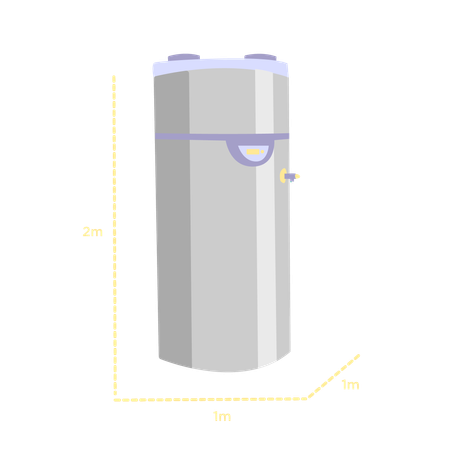
Why do you need a hot water cylinder?
Unlike combi boilers, which provide your space heating (via radiators or underfloor heating) and hot water at the same time, heat pumps are designed to do one or the other at a time. This means your home will need a cylinder to store your hot water so it can spend more time heating your home. But don’t worry, this doesn’t take long! A 9kW heat pump can reheat a 200L cylinder from 10ºC to 50°C in about an hour.
Why does the size of the cylinder matter?
Cylinder are sized in litres based on the overall volume of the tank. Inside each cylinder is a coil of pipe that heats up the stored water.
The water inside that coil flows to and from your heat pump and therefore can’t be used at the tap. So we subtract a bit for the coil (15L is a good rule of thumb) to determine the available water for a given cylinder size.
What is usable hot water and how much will I have?
Cylinders store hot water most efficiently at 48-50°C. You won’t want the water to come out of the tap at that temperature as it’s too hot! Usable hot water is recommend at 40ºC for safety and comfort. To get usable hot water at 40ºC from a cylinder of 48ºC water, the water from your cylinder will be mixed with cold mains water at your kitchen or bathroom taps.
For 48ºC cylinder water and a typical mains temperature of 10ºC, you’ll mix them at a 4:1 ratio to make nice, steamy 40ºC usable water for your bath or shower. In practical terms, that means the hot water stored in your cylinder goes 20% farther at the tap!
If you keep your cylinder at 50ºC or more, you’ll get just a bit more usable water. And if you like your water above 40ºC at the tap (for you hot shower fans 🥵) you’ll get a bit less usable water. Find guidance on how to set a schedule for your hot water here.
Which cylinder is right for you?
We’ve included the table below as a guide to what you can expect out of the cylinders size we install.
| 2-3 people | 2-4 people | 3-5 people | 4-6 people | |
|---|---|---|---|---|
| Cylinder size | 180L | 200L | 250L | 300L |
| Available water | 160L | 180L | 230L | 280L |
| 40ºC Usable Water | 200L | 225L | 285L | 350L |
| 10-minute showers at 40°C | 2 | 2-3 | 3-4 | 4 |
| Full baths at 40°C | 1 | 1 | 2 | 2-3 |
| Continuous hot water 40°C & 8L/min | ~25 mins | ~25-30 mins | ~35 mins | ~40 mins |
| Cosy 6 reheat time 10°C - 48º C | ~70 mins | ~80 mins | ~100 mins | ~125 mins |
| Cosy 9 Reheat time 10°C - 48º C | ~45 mins | ~50 mins | ~65 mins | ~80 mins |
How far your cylinder water will go on a daily basis depends mostly on how you use it. For a 10-minute shower, you’ll use around 80L of 40°C hot water, while bath uses 100-120L of 40ºC hot water.
How much space will the cylinder need?
Cylinders can take up more space than you expect. Generally speaking, if the cylinder location you have in mind can fit a full size fridge-freezer, it should work. There are many suitable locations, but typical spaces include airing cupboards, garages, utility rooms, lofts (subject to weight limits and a structural survey, which may cost extra) and some crawlspaces (although the space also needs to accommodate the people who will be installing it as well, and anyone who may need to repair it in the future!).
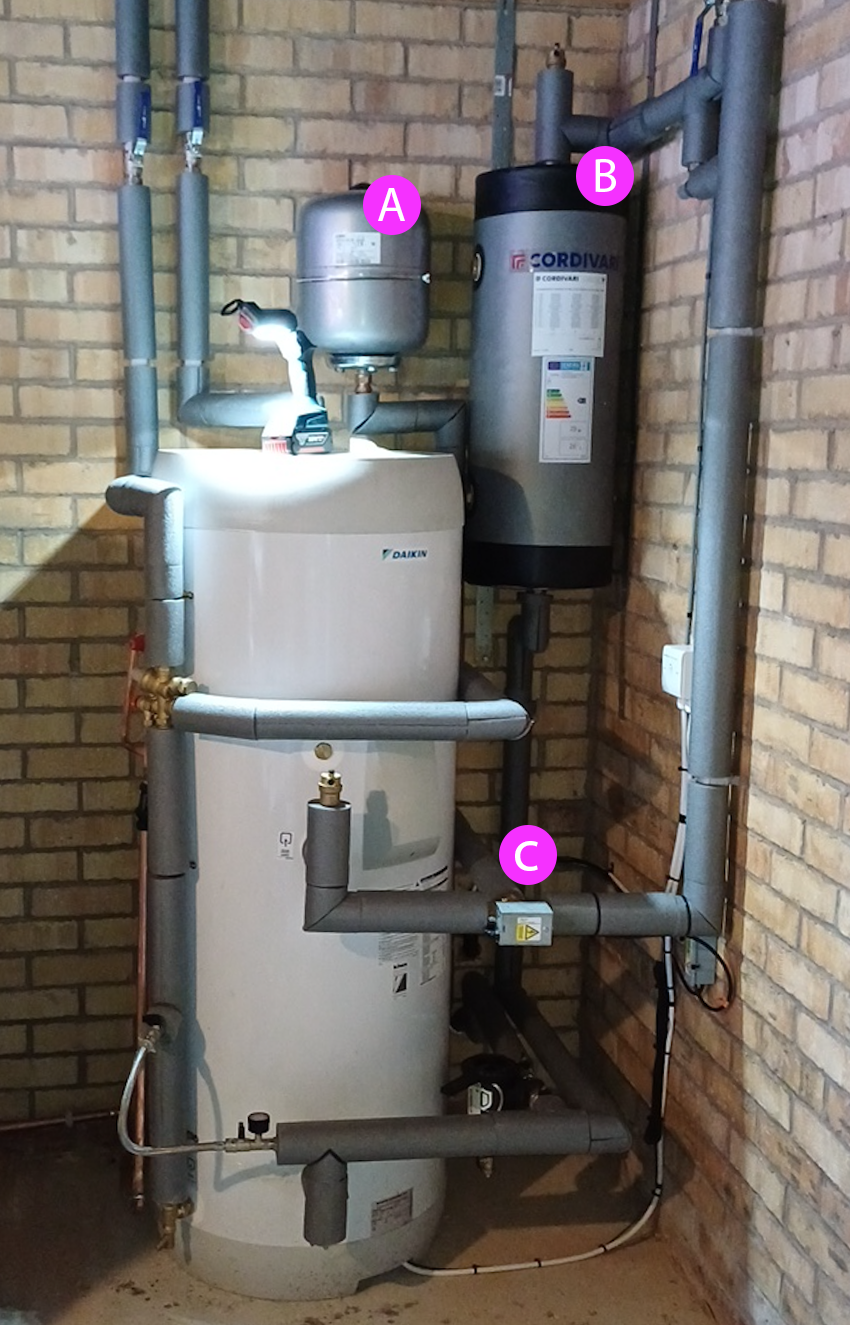
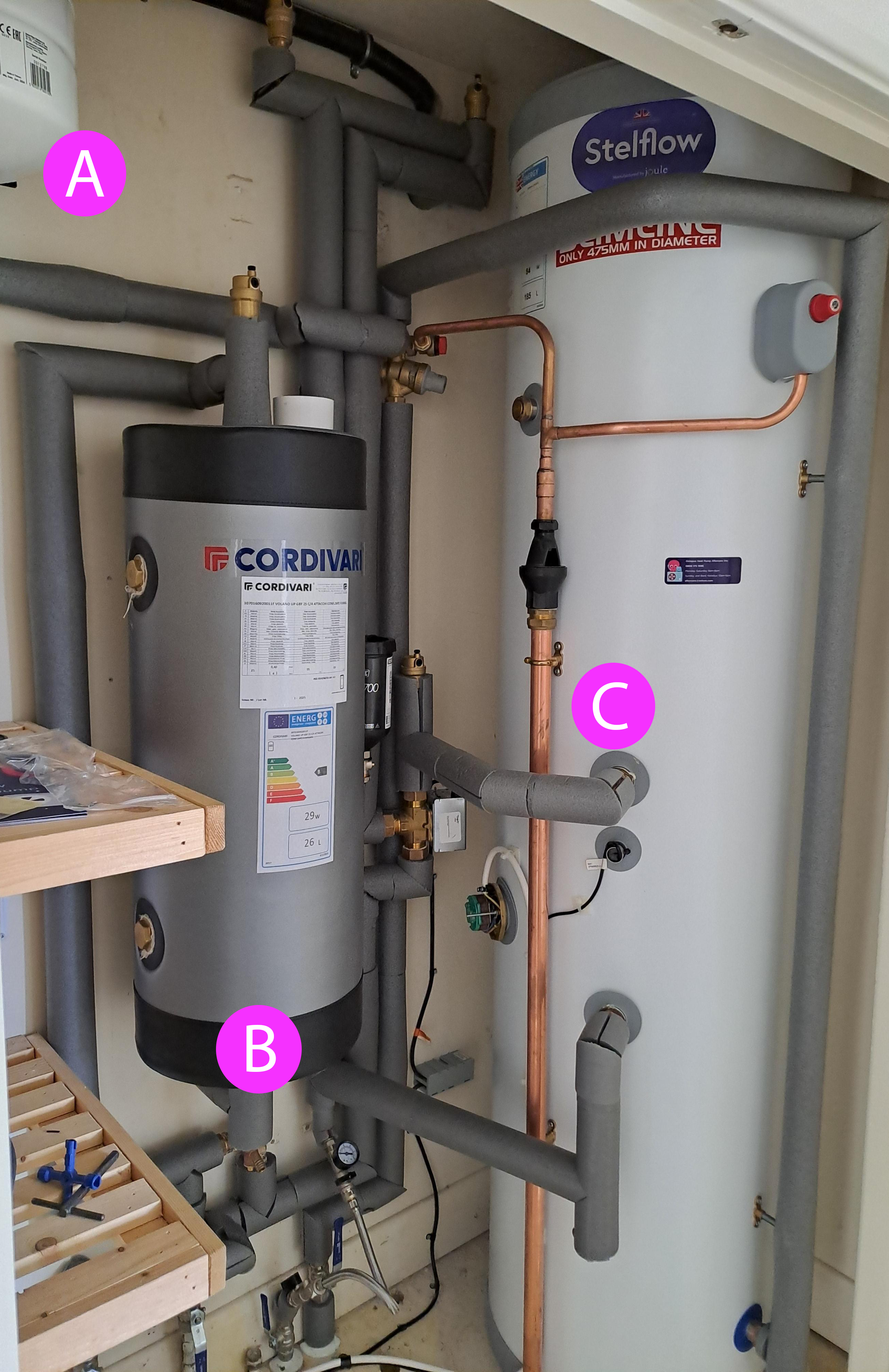
A cylinder isn’t the only thing we’ll be installing in your home. A full system includes the additional components listed below, plus all the necessary pipework and electricals. These also require space and can influence where we are able to install your cylinder. Where we are limited by space, our installers may be able to install some of these components in a different location. We generally confirm this during your survey, but this is subject to change during the installation as needed. It's also worth saying that if you already have a hot water cylinder that's compatible with an Octopus heat pump install, you should be able to keep it.
Other components we’ll fit in your home
A. Expansion vessels Specialised small tanks (about the size of two footballs) that help maintain system pressure. We’ll fit one in your home for a Cosy and two for other models of heat pump.
B. Volumiser (or buffer) Medium sized tank (about the size of a golf bag) that holds extra water for various system functions (we use the same tank whether it’s configured as a volumiser or buffer)
C. Pumps and valves Depending on the layout of your home and your heating system, we’ll install one or more valves. We’ll also install pumps if needed (though most homes don’t require this).
Below are photos from real customer homes showing what a complete system might look like inside your home, with labels to help you visualise each component.
Back to the heat pump support page
The best ways to run your heat pump
How to save with a heat pump schedule
For up to date savings for our Cosy heat pump customers, head to our dashboard, updated weekly here
Our typical heat pump price is £4,064, which is lower than the national average of £5,408
This is the median post-survey price from all of our heat pump quotes after the £7,500 Boiler Upgrade Scheme has been applied, between 01/06/2026 and 30/09/2026. The national average is taken from the Boiler Upgrade Scheme statistics: April 2026 – median cost of installation Q3 2026.
Cut carbon emissions by 85% with a heat pump
This is the typical reduction in heating carbon emissions using an electric powered heat pump compared to a gas boiler.
The carbon breakdown
Gas CO2 (tonnes per year) - 2.00
Electricity CO2 (tonnes per year) - 0.31
Carbon saving (tonnes per year) - 1.69
Data sources and assumptions
Gas Energy Usage (kWh) 9500 (Ofgem medium use gas usage (Oct 2026))
Heat Pump Efficiency 312% (typical seasonal coefficient of performance from a fleet of Octopus high temperature heat pumps)
Gas Boiler Efficiency 85% (The typical gas boiler efficiency from a BEIS study)
Gas fuel emissions of (gCO2/kWh) 210 (SAP 10.3)
Electricity fuel emissions of (gCO2/kWh) 119 (SAP 10.3)
Based on these sources, heat pumps typically produce lower operational emissions when heating the home than gas boilers.
For more information, explore our Octopus Cosy heat pump fleet performance dashboard.
We're the largest heat pump installer on the Boiler Upgrade Scheme
Based on Octopus benchmarking against Ofgem reports from 2026, and we've continued to grow since.
Our customers love their heat pumps!
93% of people say it's the same or more comfortable than their previous boiler
87% say it costs the same to run or less
83% say it's the same noise or less than the previous boiler
90% say it's just as easy or easier to maintain
We survey all our heat pump customers 3 months post-installation to see how they find their heat pump compared to their previous gas boiler. Survey results are taken from a sample of 2,837 customers:
Comfort: 93% of people say it is the same or more comfortable than their previous boiler.
Running Costs: 87% say it costs the same to run or less.
Noise: 83% say it is the same noise or less than the previous boiler.
Maintenance: 90% say it is just as easy or easier to maintain.
A heat pump is around 4x more efficient than a gas boiler
Heat pumps don't generate heat by burning fuel. Instead, they transfer existing heat into your home. This means they can deliver multiple units of heat for each unit of electricity used.
Based on performance data from a fleet of installed Octopus Cosy heat pumps, typical real-world seasonal performance (SPF or SCOP) is around 3.6. This means around 3–4 kWh of heat is delivered for every 1 kWh of electricity used (an effective efficiency of 300–400%). By comparison, typical UK domestic gas boilers operate at around 85% efficiency, delivering approximately 0.85 kWh of heat per 1 kWh of gas used. On this basis, a heat pump can be around 4× more efficient than a typical gas boiler.
All our heat pumps are independently tested by the Building Research Establishment (BRE), with SCOP values published on the Microgeneration Certification Scheme (MCS) product database. Actual efficiency will vary depending on the property, system design, and usage. For more information, explore our Octopus Cosy heat pump fleet performance dashboard.
The UK's most awarded energy supplier
We've won more awards for customer service than anyone else.
Heat pumps give reliable, consistent heating and hot water
The heat pump user survey report by Nesta from May 2023 summarises that "users are highly satisfied with their heat pumps". It states: "People living in England, Scotland and Wales who own their home and use a heat pump to heat it are satisfied that heat pumps are safe, reliable, quiet heat sources that are effective for space heating and producing hot water." Find the full report here.
The Cosy heat pump is quiet
Heat pump sound power levels are verified by an independent, third-party laboratory as part of the testing process for inclusion on the MCS product database. The laboratory verifies the sound power on the A-weighted decibel curve, as A-weighting closely aligns to how humans perceive "loudness".
All heat pumps are measured using EN14511 standards to ensure uniformity across manufacturers and models. Our Cosy 6 heat pump has a verified sound power level lower than many other heat pumps of the same capacity.
Heat pump heating makes the air healthier in your home
Homes with a heat pump emit far less harmful nitrous oxide (NOx) emissions than those with gas boilers and cookers, significantly reducing asthma and other respiratory illnesses. According to the Sustainable Markets Initiative Cleantech Homes report.
A heat pump can add thousands to your property value
Analysis by the Department of Land Economy at the University of Cambridge suggests a 16% value uplift for new-build homes with enough solar and battery storage to eliminate energy bills. A further study of over five million existing properties indicates a 2-3% value increase for existing homes with solar panels or heat pumps (versus like-for-like gas-heated homes), according to the Sustainable Markets Initiative: Cleantech Homes report, 2024.
As of July 2026, the average house price in the UK is £272,611 according to the Land Registry. Therefore, a 2-3% value increase for an average house priced at £272,611 would be between £5,460 and £8,190.
Heat pumps typically last longer than gas boilers
The expected lifespan of a typical gas boiler is 10–15 years. A heat pump typically has a lifespan of 15–20 years, with UK government research indicating an average of around 20 years. Manufacturer Daikin reports similar ranges. Actual lifespan depends on factors such as installation quality, maintenance, usage patterns, and operating conditions.