
How to save with a heat pump schedule
The best way to run your heat pump cost-effectively is on a schedule. If you’re on a smart tariff, we recommend taking advantage of variable pricing by boosting your home’s heating and hot water slightly during the dip periods, so you need less heat when costs are higher. If you don’t have solar panels or an EV at home, you’re best switching to our dedicated heat pump tariff: Cosy Octopus. We’ve used this for the examples below.
A typical heating schedule on the Cosy tariff
For up to date savings for our Cosy heat pump customers, head to our dashboard, updated weekly here. This guidance can help you get started, but don’t hesitate to adjust the temperature to meet your needs.
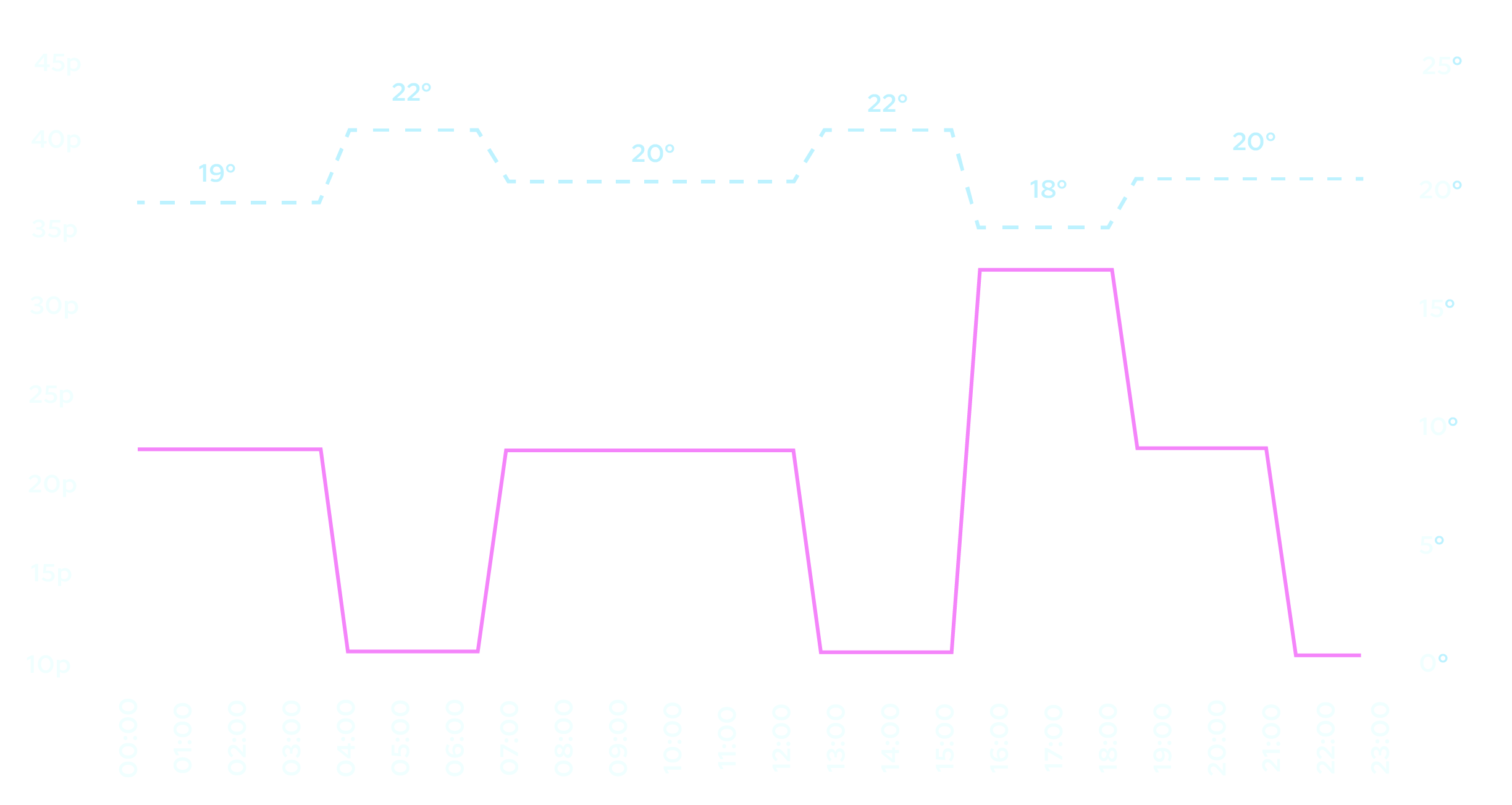
| Time period | Temperature range |
|---|---|
| Midnight - 4am (standard rate) | 18 - 19ºC |
| 4am - 7am (morning dip) | 21 - 22ºC |
| 7am - 1pm (standard rate) | 20ºC |
| 1pm - 4pm (afternoon dip) | 22ºC |
| 4pm - 7pm (peak rate) | 16 - 17ºC |
Tips for scheduling on Cosy
During dip periods, we recommend setting your temperature 1-2º higher than your normal home temperature. So if you like to keep your home at about 20º normally, set your target temperature to 22º during the dips and store up some cheap heat. These are also the ideal times to make hot water.
In the standard rate periods, you should aim for your normal home temperature – which will be 20º or 21º for most people. For the expensive peak period, turning your temperature down 2-3º will help you save money while you enjoy the extra heat you stored up.
We don’t recommend turning your heating down or off if you’re popping out, because heating the home back up uses a lot of energy. Instead, heat pumps work best when kept at a fairly steady temperature.
We recommend setting your hot water to heat during a dip period. But remember that hot water will take priority over home heating. See the next section for more on hot water scheduling.
How to maximise your savings
The good thing about heat pumps is that they function best when they’re not switched on and off, so you’ll get a more consistent temperature at home without paying a premium for it. As with any heating system, turning the heat down by 1-2 degrees can reduce heating costs, and can help with efficiency too, which you may have seen referred to as COP (Coefficient of Performance).
There are two main ways to keep heat pump costs low - lowering the cost of energy with a smart tariff and maximising the efficiency of your heat pump. Check this blog to see how both options can work for you.

Tips for setting your hot water schedule
Your Cosy heat pump can make your hot water according to a schedule and store it in your new high-efficiency water cylinder so it lasts for 8-12 hours! That means you can heat the cylinder at night or in the early morning and have hot water all day long.
We suggest setting your hot water storage temperature to 48-50º as this is best for efficient storage. (60º isn’t necessary and will make your Cosy work longer to heat the cylinder).
Hot water takes priority. Your Cosy can heat your radiators or it can heat the water in your cylinder – but it can’t do both at once. If you ask your Cosy to do both at the same time, it will always prioritise hot water, and will continue heating your home once the cylinder has hit the target temperature.
Making hot water is less efficient than space heating. This means you’ll want to make hot water in low-price periods while still leaving enough time for home heating.
A typical hot water schedule
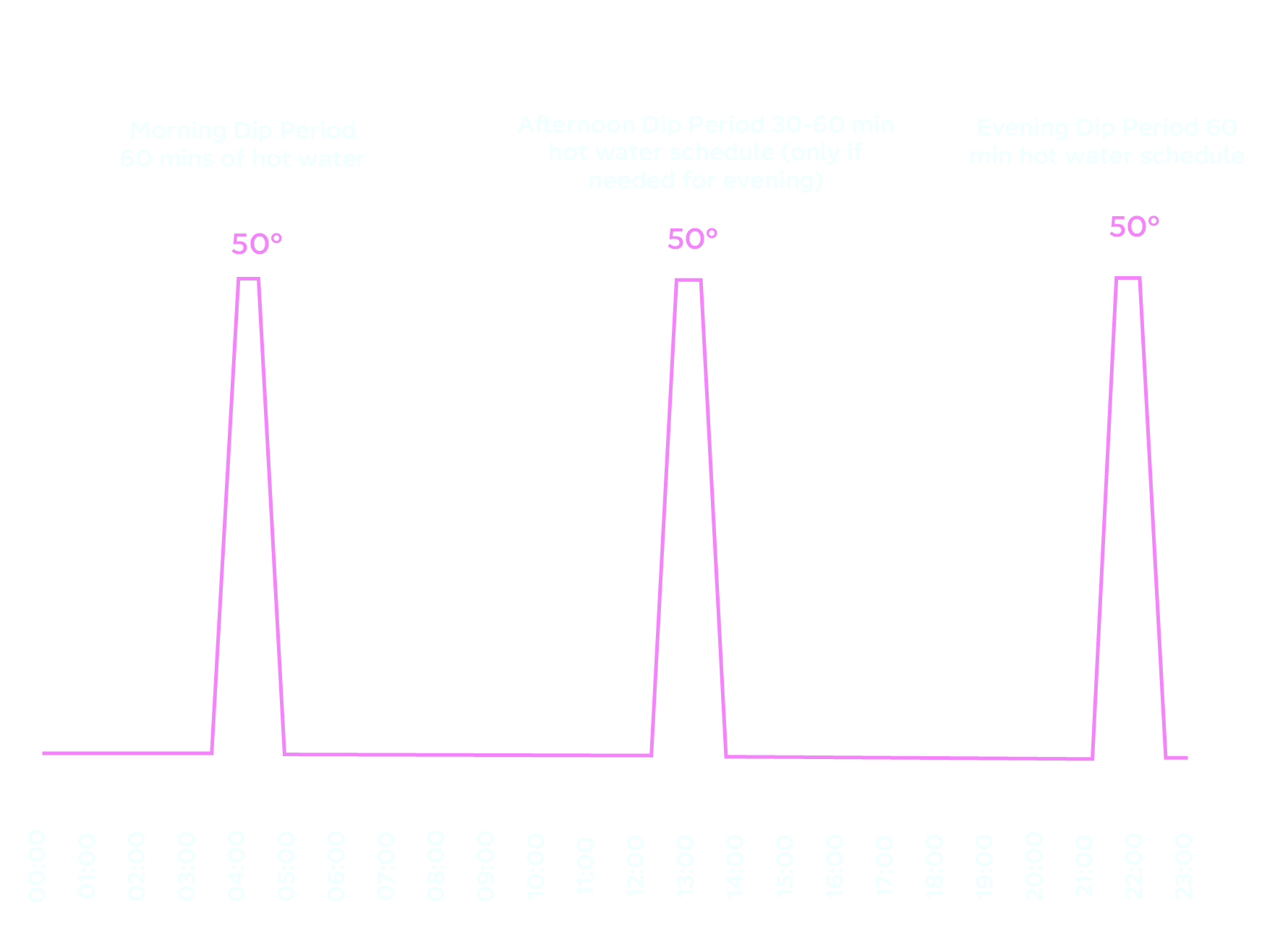
Morning Dip (4am-5am):
Ideal for morning showers – top up your tank and leave enough time to heat your home too.
Afternoon Dip (1am - 4pm):
Prefer an evening scrub? If you’ve run a morning hot water cycle, even just a 30-minute reheat in this window will ensure there’s plenty of water to use before bed.
Evening Dip:
If you use less hot water in the evening, it may be best to wait until the third dip period to make more hot water. Setting an hour window will give your Cosy enough time to heat up.
If you need extra hot water
Our MCS design ensures your cylinder is correctly sized for your property, but if expect you‘ll need a lot of hot water, follow the tips below so you don’t run out:
- Make sure the hot water is up to your set temperature before everyone starts taking baths/showers.
- Try leaving the hot water schedule on a little longer so your heat pump is still generating hot water when your busy period of hot water usage begins
For up to date savings for our Cosy heat pump customers, head to our dashboard, updated weekly here
Our typical heat pump price is £4,064, which is lower than the national average of £5,408
This is the median post-survey price from all of our heat pump quotes after the £7,500 Boiler Upgrade Scheme has been applied, between 01/06/2026 and 30/09/2026. The national average is taken from the Boiler Upgrade Scheme statistics: April 2026 – median cost of installation Q3 2026.
Cut carbon emissions by 85% with a heat pump
This is the typical reduction in heating carbon emissions using an electric powered heat pump compared to a gas boiler.
The carbon breakdown
Gas CO2 (tonnes per year) - 2.00
Electricity CO2 (tonnes per year) - 0.31
Carbon saving (tonnes per year) - 1.69
Data sources and assumptions
Gas Energy Usage (kWh) 9500 (Ofgem medium use gas usage (Oct 2026))
Heat Pump Efficiency 312% (typical seasonal coefficient of performance from a fleet of Octopus high temperature heat pumps)
Gas Boiler Efficiency 85% (The typical gas boiler efficiency from a BEIS study)
Gas fuel emissions of (gCO2/kWh) 210 (SAP 10.3)
Electricity fuel emissions of (gCO2/kWh) 119 (SAP 10.3)
Based on these sources, heat pumps typically produce lower operational emissions when heating the home than gas boilers.
For more information, explore our Octopus Cosy heat pump fleet performance dashboard.
We're the largest heat pump installer on the Boiler Upgrade Scheme
Based on Octopus benchmarking against Ofgem reports from 2026, and we've continued to grow since.
Our customers love their heat pumps!
93% of people say it's the same or more comfortable than their previous boiler
87% say it costs the same to run or less
83% say it's the same noise or less than the previous boiler
90% say it's just as easy or easier to maintain
We survey all our heat pump customers 3 months post-installation to see how they find their heat pump compared to their previous gas boiler. Survey results are taken from a sample of 2,837 customers:
Comfort: 93% of people say it is the same or more comfortable than their previous boiler.
Running Costs: 87% say it costs the same to run or less.
Noise: 83% say it is the same noise or less than the previous boiler.
Maintenance: 90% say it is just as easy or easier to maintain.
A heat pump is around 4x more efficient than a gas boiler
Heat pumps don't generate heat by burning fuel. Instead, they transfer existing heat into your home. This means they can deliver multiple units of heat for each unit of electricity used.
Based on performance data from a fleet of installed Octopus Cosy heat pumps, typical real-world seasonal performance (SPF or SCOP) is around 3.6. This means around 3–4 kWh of heat is delivered for every 1 kWh of electricity used (an effective efficiency of 300–400%). By comparison, typical UK domestic gas boilers operate at around 85% efficiency, delivering approximately 0.85 kWh of heat per 1 kWh of gas used. On this basis, a heat pump can be around 4× more efficient than a typical gas boiler.
All our heat pumps are independently tested by the Building Research Establishment (BRE), with SCOP values published on the Microgeneration Certification Scheme (MCS) product database. Actual efficiency will vary depending on the property, system design, and usage. For more information, explore our Octopus Cosy heat pump fleet performance dashboard.
The UK's most awarded energy supplier
We've won more awards for customer service than anyone else.
Heat pumps give reliable, consistent heating and hot water
The heat pump user survey report by Nesta from May 2023 summarises that "users are highly satisfied with their heat pumps". It states: "People living in England, Scotland and Wales who own their home and use a heat pump to heat it are satisfied that heat pumps are safe, reliable, quiet heat sources that are effective for space heating and producing hot water." Find the full report here.
The Cosy heat pump is quiet
Heat pump sound power levels are verified by an independent, third-party laboratory as part of the testing process for inclusion on the MCS product database. The laboratory verifies the sound power on the A-weighted decibel curve, as A-weighting closely aligns to how humans perceive "loudness".
All heat pumps are measured using EN14511 standards to ensure uniformity across manufacturers and models. Our Cosy 6 heat pump has a verified sound power level lower than many other heat pumps of the same capacity.
Heat pump heating makes the air healthier in your home
Homes with a heat pump emit far less harmful nitrous oxide (NOx) emissions than those with gas boilers and cookers, significantly reducing asthma and other respiratory illnesses. According to the Sustainable Markets Initiative Cleantech Homes report.
A heat pump can add thousands to your property value
Analysis by the Department of Land Economy at the University of Cambridge suggests a 16% value uplift for new-build homes with enough solar and battery storage to eliminate energy bills. A further study of over five million existing properties indicates a 2-3% value increase for existing homes with solar panels or heat pumps (versus like-for-like gas-heated homes), according to the Sustainable Markets Initiative: Cleantech Homes report, 2024.
As of July 2026, the average house price in the UK is £272,611 according to the Land Registry. Therefore, a 2-3% value increase for an average house priced at £272,611 would be between £5,460 and £8,190.
Heat pumps typically last longer than gas boilers
The expected lifespan of a typical gas boiler is 10–15 years. A heat pump typically has a lifespan of 15–20 years, with UK government research indicating an average of around 20 years. Manufacturer Daikin reports similar ranges. Actual lifespan depends on factors such as installation quality, maintenance, usage patterns, and operating conditions.