How much profit does Octopus really make?

Quick breakdown
We make roughly £20-£30 profit a year per customer.
Our profits are strictly capped by the government (on standard variable tariffs).
Fossil fuel producers (not energy suppliers like us) are making record profits.
We're working hard to bring bills down and we need action from the government.
When bills go up, it’s easy to assume that energy suppliers are pocketing the difference. We’ve always believed in being honest, so we want to be transparent about how the numbers work and where your money is really going.
The reality of selling energy
There’s a common misconception that energy suppliers are making massive windfalls from rising bills. It just seems logical, right? How can it possibly cost so much to heat your home or run the tumble dryer? Someone must be raking it in. The truth is, it’s not us – or really any energy supplier for that matter. Our margins are extremely lean. We make roughly £20-30 profit per customer on a typical £1,700 yearly bill) — just enough to keep the business sustainable and resilient.
The idea that you should have to switch supplier every year in order to avoid getting literally ripped off is absurdGreg Jackson, Octopus CEO, appearing before a select committee in 2017 to call for an energy price cap
Our profits are actually capped by the government . . .
Energy is one of the only industries where that’s the case – and it’s something we campaigned tirelessly for when we were a tiny startup. The resulting regulation, the energy price cap, eventually became law to help stamp out the immoral “tease and squeeze” tactics that used to penalise loyal customers.
The energy price cap says suppliers can’t make more than a small percentage of profit - usually around 2.7% - on an annual bill for a customer on a standard variable tariff. (Ours is called Flexible Octopus).
. . . and we regularly cut into them even further
Every price cap we set our standard tariff below the maximum we’re allowed to charge. We’re the only large supplier that’s always done that. It costs us millions of pounds every time we make that decision: in total, up to August 2026, we have spent £185 million holding everyone’s prices cheaper (which includes discounting standing charges), without them having to do anything.
We wish we could cut them by much more but as you can see, the margins are already really slim. Remember, even if we set the MAXIMUM price we were allowed we’d only be allowed to make 2.7% profit on each standard variable rate customer. And we actually make less on our other tariffs.
We cut further into our profits by spending on our Octo Assist fund. Last year, for example, that cost us £18 million.
Inside the price cap: Ofgem's graphs
Pinch and drag to zoom in on mobile
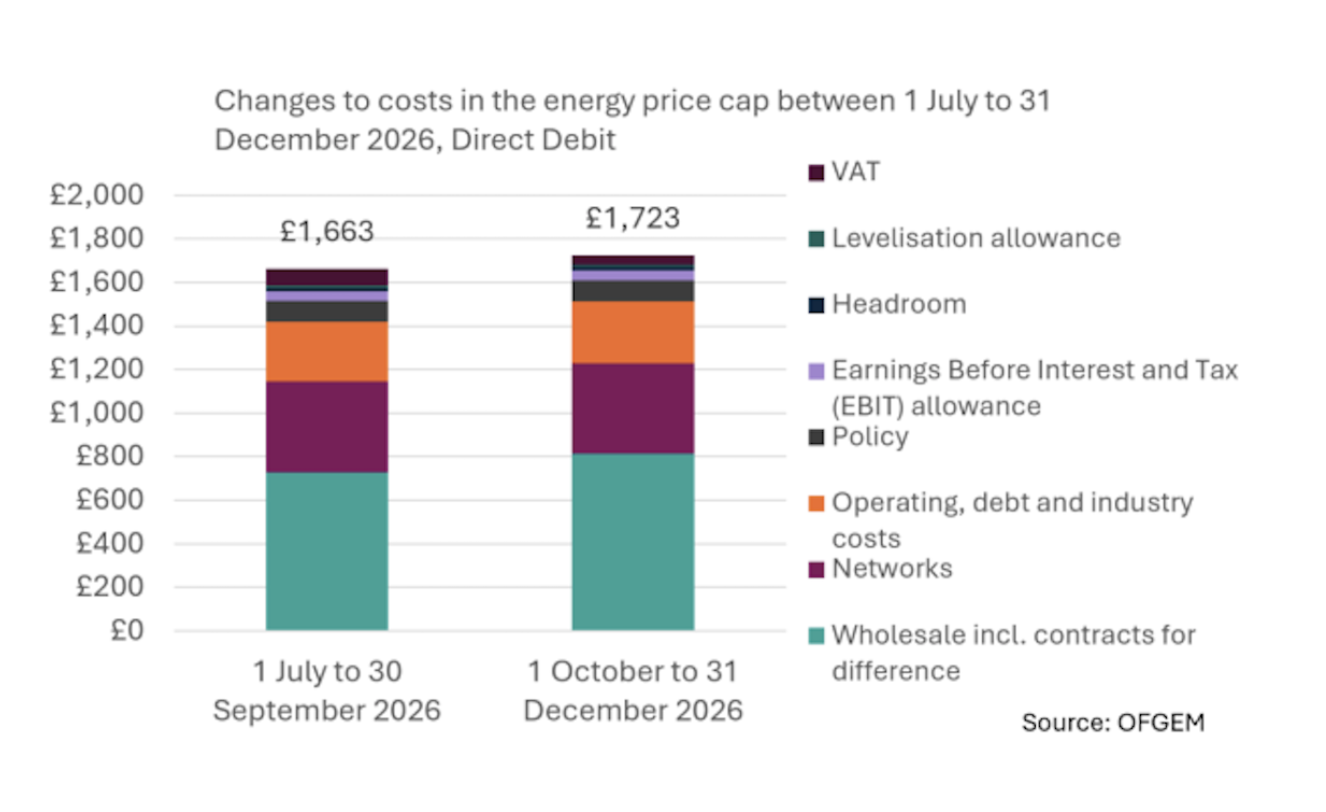
See that tiny light purple sliver labelled “Earnings Before Interest and Tax (EBIT) allowance? That’s the max we are allowed to make from any customer on a standard variable tariff (and we make much less on other tariffs).
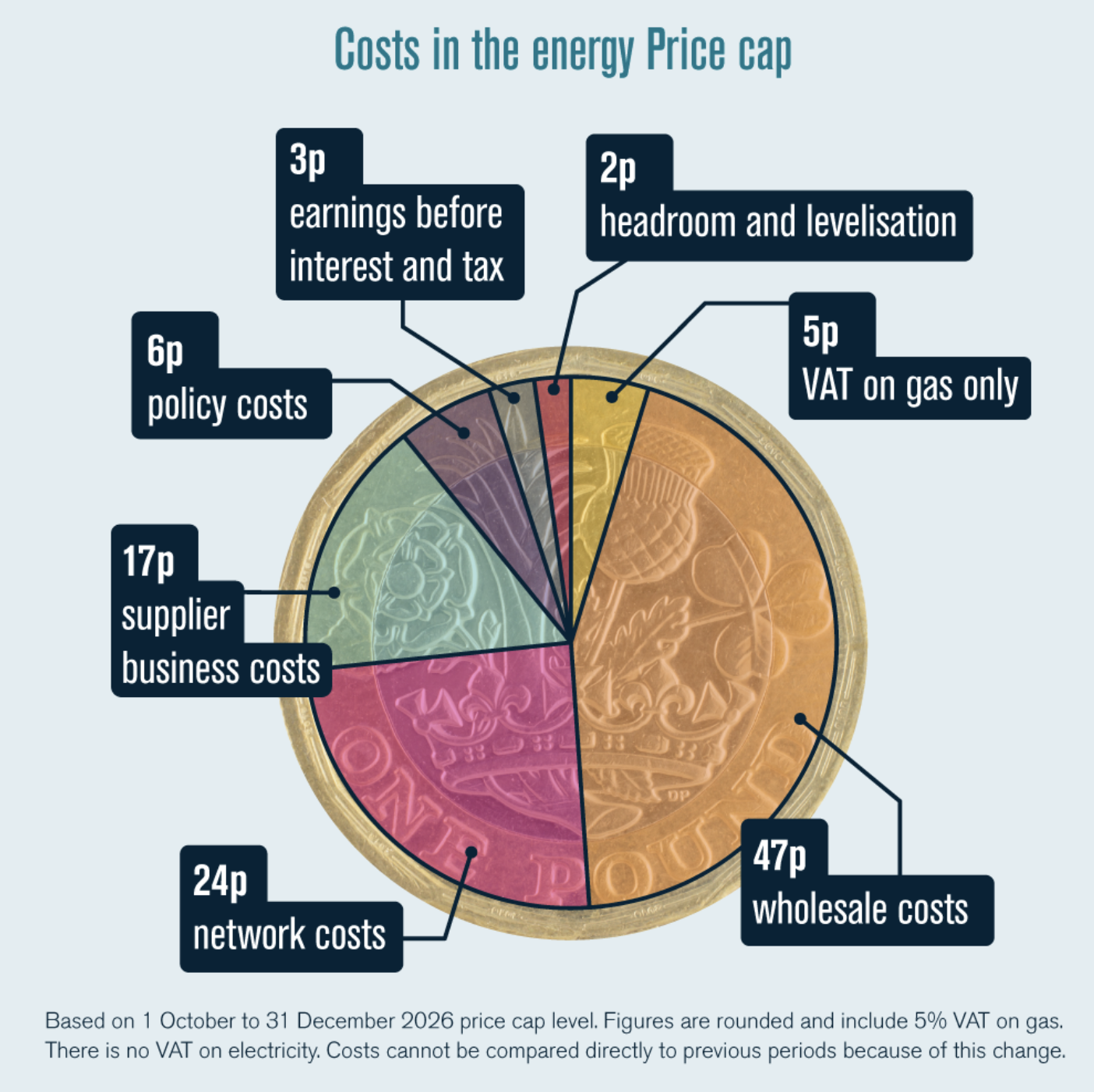
This is the same information, shown as a proportion of each pound spent by a standard variable rate customer. Here, the amount suppliers are allowed to make is shown as "3p: earnings before interest and tax".
OK, but who is making money from high energy prices?
The reality of the energy market is that when the war in the Middle East forced prices up suddenly, energy companies like Octopus didn’t rake it in. But fossil fuel companies certainly did.
As the Guardian reported in August, eight of the biggest oil and gas companies in the world amassed profits of more than £67 billion in just three months as the Iran conflict spiked energy prices. That’s about twice what they made during the same period last year.
But it’s not just those eight. Gas is a global market, so the price everywhere is set based on global supply and demand. That means that the gas generators we buy from (and electricity too, since around 40% of Britain’s electricity is gas-generated) also charge that exorbitant rate and pocket the profit.
£67bn
Extra profit taken home in just three months by eight of the biggest oil and gas companies in the world as the Iran conflict sent prices soaring.
It is hard for humans to even process “£67 billion”. It’s just too big a number. But if you’ve recently found yourself unable to afford your weekly shop because you spent all your money on your energy bill, just know that you were adding to that £67 billion profit.
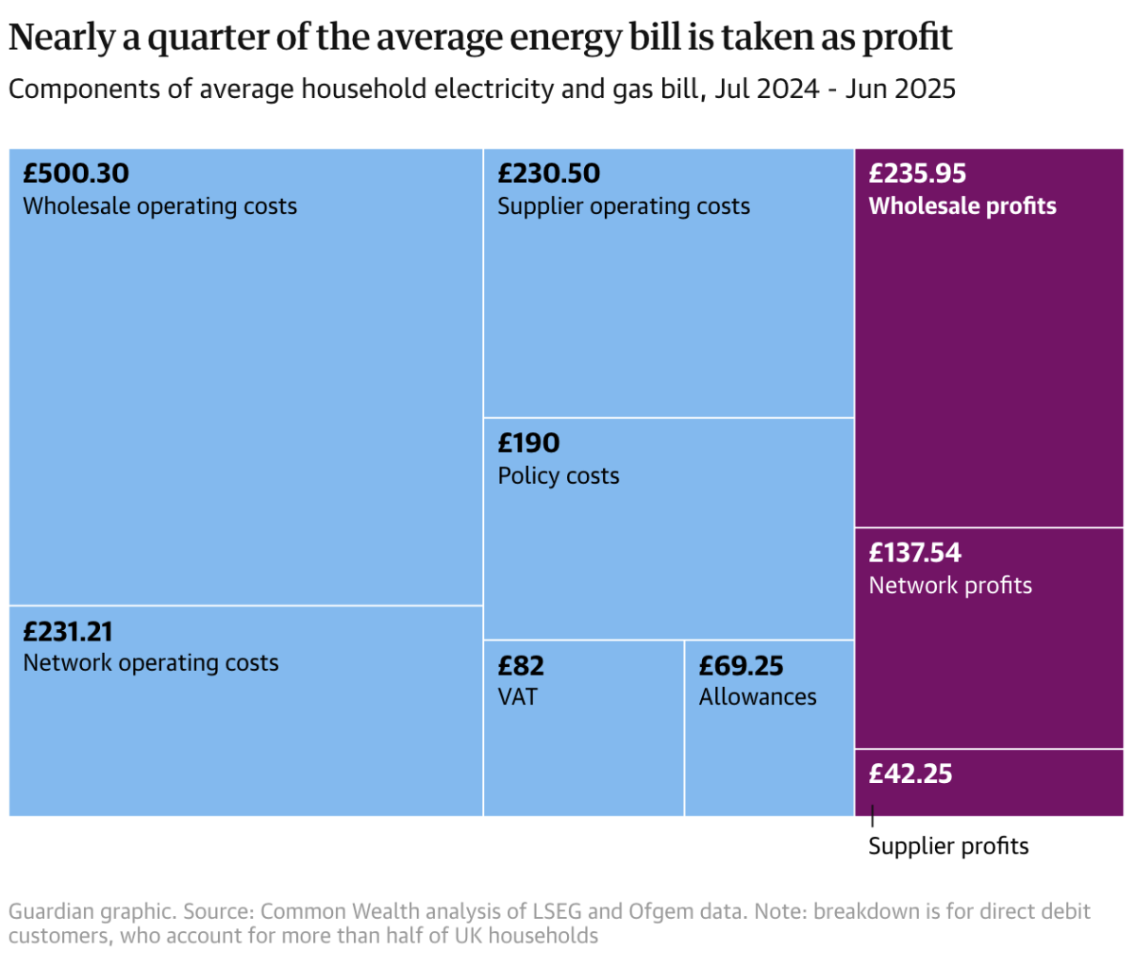
The networks (the companies that own the physical pylons, wires, and gas pipes that deliver energy to your home) also make serious profits. The below graph is part of brilliant research done by The Guardian last year. It's not up-to-the-minute, but it gives a good idea of how much network profits are adding to your bills.
Pinch and drag to zoom in on mobile
Why we can’t slash prices right now
Lots of people assume we just make the power ourselves somehow and decide what to charge. That’s not the case. Even when we buy power from OEGen (from our two wind farms), the price is regulated to make sure it’s a fair market price. The vast majority of our energy is bought on the open market.
Think of your local Tesco
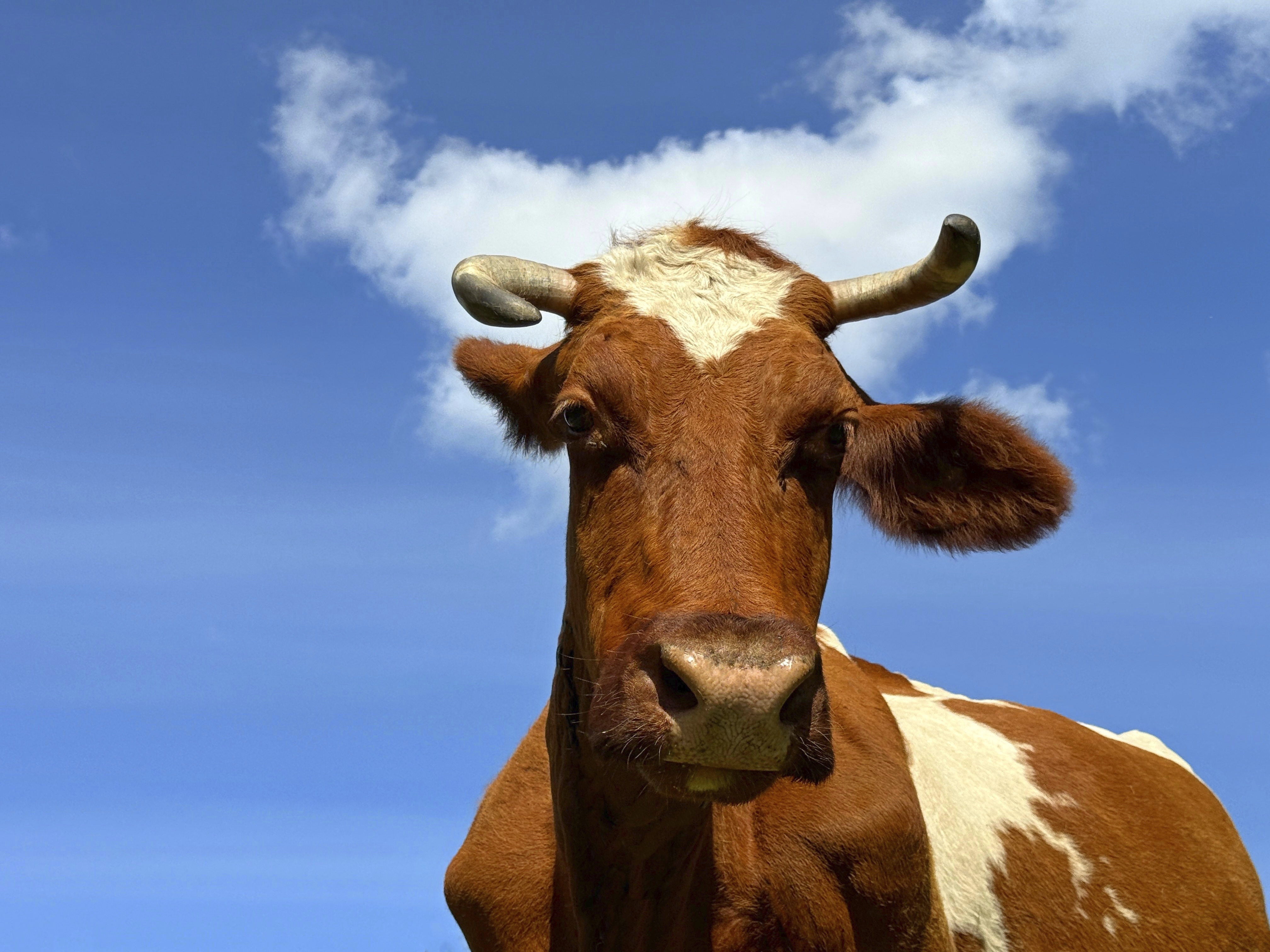
They don’t have a secret tractor ploughing a wheat field in the stockroom, or a dairy cow roaming the store (erm, clean-up on Aisle Four!). They have to buy the Shreddies and the milk, which means paying the suppliers for the produce, the delivery vans to bring it there, the staff to put it on the shelves and the power that keeps the milk fresh.
It’s the same for us. As well as buying the power, we have to:
pay the “delivery drivers” (the networks who own the pipes and wires that bring it to your home)
and the staff who look after your accounts
PLUS we face a ton of extra costs, like government schemes (eg the Warm Home Discount Scheme) and maintaining the grid.
As Greg Jackson said in a recent interview, this all means that suppliers face hundreds of pounds in fixed costs per customer each year before a single unit of power is even used.
That’s why, as much as we’d love to, reducing standing charges by much isn’t really practical. We have to pay the costs regardless, so we’d have to add it to your unit rate (how much you pay for actually using power) instead — or we simply wouldn’t be able to survive. Just like Tesco can’t keep the price of milk the same if the farmers double it.
Bringing down overall costs is the only real answer. And like any big, complex system, the British energy system is full of inefficiencies and outdated rules that, if addressed, could absolutely slash those operating costs. More on that below.
Leadership that shares the load
We don't think leadership should be insulated from the realities our customers are facing. Our CEO, Greg Jackson, has never taken a bonus and his pay (in the low six figures) is a fraction of what other Big Six energy bosses take home.
So what would ACTUALLY bring your bills down, and how are we helping?
We’ve long argued that we need more energy independence so that global shocks don’t hit our bills so hard. More wind and solar get us far closer to that goal, but we also need serious market reform, including matching demand and supply locally, which would make the system more efficient and lowering bills for everyone.
The problem is that, at present, even green electricity is priced according to gas costs. If we decoupled gas from electricity, we could sell renewables far more cheaply and electricity bills could drop.
We’re pushing the government on that, but the fix may be a long time coming and we know that so many people are fighting to keep their heads above water right now. Our Octo Assist fund has already spent £60 million helping customers who are struggling with their bills.
Published on

Nicki Slater-Arnold
Energy Writer