

How do I get the energy price cut from April 2026?
Energy prices are dropping from April 1st, driven by the government cutting some levies from electricity bills.
We know how much Brits needed some relief. We fought hard for this change and we’ll keep fighting for fairer prices.
You don’t need to do anything: we’ll automatically apply the savings to your tariff.
Here’s what you need to know.
How do I make sure I get the price drop?
Short answer: you don’t need to do anything; we’ll apply it for you automatically.
- On a fixed tariff? Even though you've locked in your rates, we’ll lower your electricity and gas unit rates on April 1st to pass the savings on to you until the end of your fix. After that, you’ll get new tariff options based on the latest market costs (which will also take the policy drops into account).
- On a variable tariff (Flexible Octopus)? Your rates will automatically drop on April 1st as part of the new, lower energy price cap. The latest cap includes the government's cuts.
Hear from our founder, Greg Jackson, on what the price drop means for you:
Why are prices dropping?
Back in October, we gave the government a stark warning about the impact of spiralling policy costs on customers. In the November ‘25 Budget, the government acted: announcing they would cut ~£150 of policy costs off the average energy bill, starting from April 1st.
Today, the regulator made that pledge a reality when it set the energy price cap for April – a cut of £117, or around 7% – for a typical dual-fuel customer.
The price cap protects customers on standard variable tariffs, but we pledged to pass these cuts on to all our fixed tariffs as well, so that even customers with locked-in prices could see the benefits immediately. We’re really pleased to see other suppliers have followed suit.
How much will I save?
The saving is a reduction of your electricity and gas unit rates, so how much you save depends on what you have and how much you use.
- On a variable tariff at the max energy price cap, the savings will be equivalent to around £117 a year for a typical medium-sized house.
- On a fixed tariff, the savings will be equivalent to around £130 per year for a typical medium-sized house.
Why are fixed tariff customers likely to save a bit more?
Policy costs are just one part of the bill. Other costs (like network costs) have increased slightly. Flexible Octopus customers will see the impact of all the different cost changes on April 1st when the April price cap comes in.
Fixed tariff customers have locked in their prices to avoid these increases during their fix, so they’re just getting the policy drop. After your current fix ends, you’ll get new tariff options based on the latest market costs (which will also take the policy drops into account).
The government said they were cutting costs by £150. Why is the energy price cap only dropping £117?
While wholesale prices and policy costs have gone down, other costs have shifted or gone up to offset those savings.
Here is a breakdown of exactly what is changing in the new price cap for a typical dual-fuel customer:
- Policy costs are down £130. This is the real impact of the government's changes, mostly made up of cuts to green levies, rather than the £150 initially quoted.
- Wholesale costs are down £38. The cost of buying the energy itself has dropped.
- Other costs are down £15. This includes reductions in things like supplier margins and VAT.
- Network costs are up £66. This increase helps pay for massive upcoming grid upgrades.
When you add all of these up, the average dual-fuel bill drops from £1,758 down to £1,641 — an overall saving of £117.
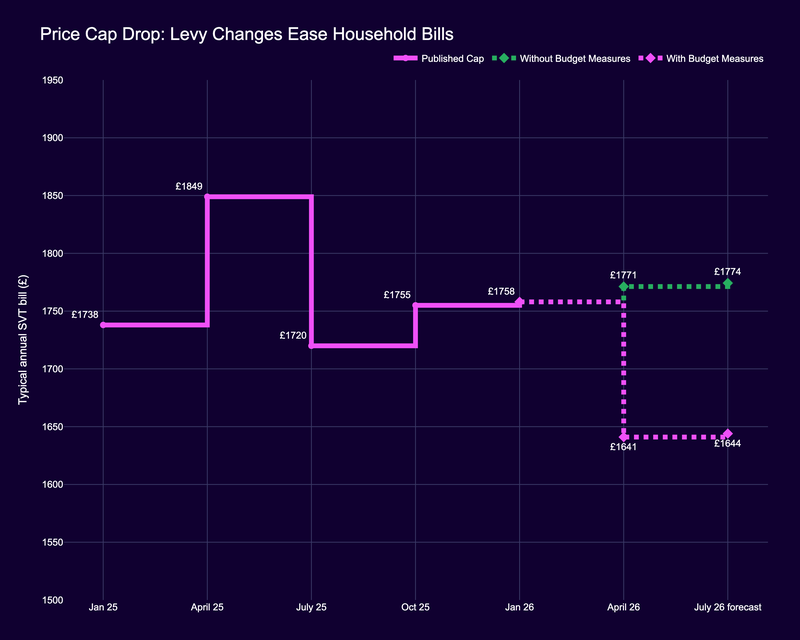
July forecast is based on the latest available information and is subject to change
Is this change only for summer?
No. The government is removing £126 linked to green levies from your bills and they've promised to keep it that way until 2029, so you'll feel the benefit far beyond summer. We know bills are still too high and we’ll keep fighting for longer term savings but this is a good start. This is just one part of the bill though: other costs could change
Which green levies has the government cut?
The Energy Company Obligation scheme, which was designed to tackle fuel poverty and reduce carbon emissions, has been scrapped, slicing £60 off annual energy bills. It required energy suppliers to fund energy-efficiency upgrades such as insulation, mostly for vulnerable households, and had been criticised over the quality of some of the upgrades it funded.
The other major change is to do with the Renewables Obligation, which requires electricity suppliers to source a specific proportion of the power they sell from renewable sources. This one is not ending, but the government has announced that 75% of the costs associated with it will be shifted to general taxation until 2029, reducing energy bills by £66 this year.
Where do we go next?
We know how badly Brits need their bills to come down.
Energy is the second-biggest household expense after rent or mortgage.
We’ve got a long history of fighting for fairer bills – back in 2018, when we were just a tiny startup, we led the charge to bring in an energy price cap while incumbents fought against it. And we’ve been fighting ever since.
Our director of regulation, Rachel Fletcher, addressed parliament back in October with a stark warning that policy costs were getting out of control. Her message got cross-industry support from other large suppliers and we're so pleased to see the government take action on behalf of customers.
So, this is a welcome change, but it’s just the beginning. British energy bills remain some of the highest in the world.
We'll keep working relentlessly to make energy fairer for all.
What's happening to standing charges?
Overall, gas standing charges have fallen but electricity standing charges have risen slightly, This is because some costs (about £35) associated with delivering the Warm Home Discount scheme have been moved from the standing charge to the unit rate. By tying it to how much you use, rather than making it a flat rate, the government’s aim is to cut costs for households that don’t use a lot of energy (which often include low-income families). Meanwhile, the costs associated with maintaining and upgrading the networks have increased.
We still think that standing charges are too high. A huge part of them is down to network upgrades and we think these could be a lot cheaper and more efficient. We are taking part in a low standing charge tariff pilot with Ofgem, but we want to make sure that costs are actually reduced, not just shifted to different parts of the customer's bill.
Our Flexible Octopus price has typically had some of the cheapest standing charges of a large supplier and we offer standard waivers to thousands of the most vulnerable customers through our Octo Assist fund.
What’s the difference between the government’s ‘policy price drop’ and the energy price cap?
- The government announced cuts to energy policy costs in the last Budget (November '25), coming into force from April 1st.
- The energy price cap is set quarterly by Ofgem, the energy regulator, based on the latest supply costs (including policy changes). It sets the maximum rates a supplier can charge on a variable tariff. The April ‘26 cap factors in the government’s policy cost cuts.
How does it work for smart tariffs?
If you’re on a fixed smart tariff, we’ll apply the policy cut to your rates automatically from April 1st. If you’re on a variable smart tariff, we update our prices every so often based on the latest market costs and will apply the policy cuts on top of that from April 1st.
Published on 25th February 2026 by:

Hey I'm Constantine, welcome to Octopus Energy!
×Close window